Monthly Archives: April 2013

Aural tests – just sing!

I have discovered the most wonderful resource for musicianship training – canonsSo much can be covered with the simplest of four bar canons, and perhaps the greatest beauty of all is that you need nothing more than two voices.

Take the following example:

canon3


The first objective should be to sight-sing the melody using solfa. I insist that my pupils do this, for two reasons. Firstly, it gives each note its place value in the key. And secondly, it is extremely focusing to be thinking about both pitch and syllable  – there is no room for passive participation here! Initially even a simple melody may prove quite testing, but this active engagement of the brain, this constant thinking ahead, is an excellent skill to be developing right alongside the aural skills.

Alternatively, or perhaps after an initial attempt at sight-singing, you can learn to sing it from memory, perhaps in two halves at first, but still using solfa.

With a more able pupil, you might dive in straight away and ask them to sing after you, in canon. This allows them either to read the notes as they sing, or else to memorize what you sung and follow that way – or ideally a combination of both. Still in solfa. They might get the notes right but a few syllables wrong – don’t allow them to get off lightly! Even if they get the melody perfectly correct, insist that the solfa is correct too, even if it takes a few more attempts.

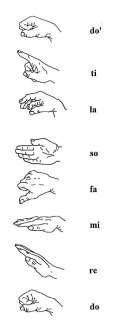
And then there are the hand signs! These can be introduced whilst you are just singing in unison, and your pupil should sign too. The ultimate test, of course, is to sing the canon whilst signing the second part a bar later. But be warned, make sure you have practised this before you demonstrate in front of your pupil – it’s not easy!

A quick glance down the aural test requirements for the early ABRSM grades will show you just how much a little of the above covers:

  • Pulse. Singing together and in canon enhances an awareness of both rhythm and pulse.
  • Echo responses. Memorizing short phrases.
  • Recognising changes. Singing in canon requires careful listening to both rhythm and pitch, and students will soon be identifing their own errors.
  • Sight-singing notes in free time (Grades 4 & 5). The key here is solfa, and learning a few tuneful canons in this way will soon make the ABRSM tests seem insultingly easy.
  • Sing back a phrase. No problem – your student can now sing back a phrase at the same time as listening to how it continues!
  • Tonality. The place value which solfa brings (you just can’t sing mi without having worked out that it is the 3rd of the chord) is excellent for developing a sense of key, and singing in canon also encourages the student to listen carefully to the harmonies produced between the voices.
  • Singing back the lower/upper part. Once you have practised a few example, see whether your pupil can sing in canon without sight of the music; this really does develop their ability to hear one part and sing another.

I find teaching the ABRSM tests in order to pass the exam to be a pretty painful experience – but just learning and singing together a simple canon, even for a few minutes each lesson, is quite the opposite. Delightfully pure and simple, but incredibly focusing for both pupil and teacher alike. Let’s put the instrument down, or step away from the piano for a few moments, and sing!

This canon is the very first in a book of 109 canons selected by David Vinden in ‘Two-part hearing development” which is available here.

Plus …. a fab solfa video here!
As easy as do re mi? A “beginner’s” guide to solfa

For as long as I can remember I have been able to sight-sing with confidence, doubtless due to my early training as a chorister and subsequent involvement with choirs for many years since. It still remains, for me, the most important thing for any musician – to be able to sing.

Three years ago I signed up for a British Kodàly Academy Spring Course. I can’t quite remember why, but one of the things which did interest me was the knowledge that the Kodàly approach uses solfège, the naming of each note of the scale as do, re, mi, fa, so, la, ti, do. I was interested to see whether there was anything in it, since I had my doubts – after all, I could sight-sing perfectly adequately without, so what possible use could giving all the notes funny names be to me? As I soon discovered, I was missing the point.

The first event of Day One was choir. We learned a song from memory by repeating back phrases sung by our director, which was challenging for one reason only – we were expected to sing in solfa! For me pitching the notes was easy, but remembering which solfa name to sing them to was not, and immediately I found my brain racing to keep up. And it was relentless! Just as I thought I had the hang of it, we cut to something different – learning another melody, or clapping and/or stamping a complex syncopated rhythm. And then (I should have seen it coming!) we put all of them together; melody, rhythm, others singing the countermelody, and the solfa! By the time the hour was up I felt like I’d done a day’s mental workout. They say that music uses both sides of the brain – definitely!

HandSigns

And then on to musicianship training. I was aware that there are different hand signs for each of the solfa syllables, but was not yet aware of their full potential. We learned some relatively simple pentatonic melodies from memory, and again the most difficult element was singing the solfa names. By now I realised that I was becoming much more actively aware of the relative position of each note in the scale, rather than just pitching each note from the previous one. The latter system still worked for the pitch, of course, just not for the name. Interesting. And then we were asked to perform a melody in canon. First at the piano; play first, and start singing a bar later (in solfa). Challenging, but manageable, and I have to say I felt very proud of myself for negotiating the task successfully, albeit with my brain running at full tilt. And then with hand signs. That’s right, sing first (in solfa) and then sign the canon a bar later with the solfa hand signs. “You’ve got to be joking” I said to Klara, the delightful Hungarian lady who was taking our class. Evidently she wasn’t. As encouragement, she performed the canon in three parts, using both hands, without even breaking a sweat! Respect.

Back in choir, I soon discovered that when the music changes key, do moves too – and so of course does everything else! Never before have I been so intensely aware of the place value of each note in a melody, and in observing every modulation as it occurs. I realised that much of the time I sight-sing on autopilot; yes, I am constantly listening, but perhaps not always thinking so hard. On the other hand, solfa actively forces you to listen and to analyse, and the intensity of this experience is actually very surprising. It is an amazingly powerful tool for teaching complete novices (as my Choir who can’t sing will testify) right through to analysing Schubert symphonies in detail, which I did on this year’s Spring Course.

This approach to musicianship is so refreshingly rigorous, and I love it!