Monthly Archives: October 2013

Reading notation: Know it, don’t read it

I have recently taken on a new piano pupil, and I was surprised to see that in several passages of a piece which he had been learning he had written the names above all of the right hand notes. Most of these notes were on leger lines above the treble stave, and he had evidently found these difficult to read – well they are more difficult to read aren’t they? 
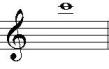
Ledgerlines

However, what he had failed to notice was that the left hand was just an octave lower than the right throughout. Which means that he didn’t actually have to read the right hand notes at all. He could play it okay, but I just don’t think it had dawned on him that a little bit of knowledge (in this case simply ‘hands an octave apart’) was much more helpful than knowing the names of all those notes.

This is a classic case of being so concerned with reading the score that we forget to observe the glaringly obvious. When I pointed this out, he was equally bemused as to why he had written on his score!

I set him a new piece to learn: To a Wild Rose by MacDowell. He did a brilliant job of learning it in just a week, but to my surprise he had written in all the note names in the right hand, just for a couple of bars.
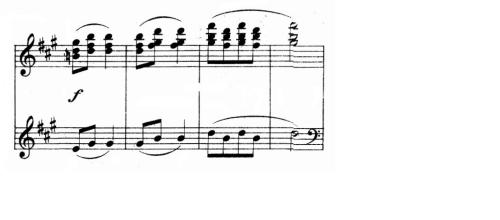
wild roseHe was relying entirely on his reading skills to help him to recall these notes, and as already highlighted, leger lines aren’t his favourite! But there are other things which can help here:

  • we noticed that the bottom line traces a chord of E7, and the top line is also a succession of rising thirds
  • the first two bars have sixths between top and bottom notes in the right hand, and these extend to sevenths in the second two bars
  • the physical shape of the right hand chords, and in particular the different combinations of black and white notes, enable us to remember what they look and feel like.
  • a second finger on the B in the third bar gives a secure link between the alternating chords, again helping to forge a physical connection between the two chords

Taking a passage like this apart, and noting all of the musical, theoretical, physical and aural connections, will ensure that we really know it. And in many instances, our aural or memory skills might be better than our reading skills, in which case why rely solely on the reading skills? In short, we shouldn’t; we need to be prepared to use all of our musicianship skills, all of the time.

Reading notation: If you can’t say it, you can’t play it

When learning a piece of music – and when teaching a new piece of music – I always consider how I can make things as easy as possible, and this invariably means breaking the music down into tiny pieces so that every element is as simple as possible. For a pianist, that might well mean separate hands, but even beyond that it might be to break down each bar so that we can identify different hand shapes, finger patterns, harmonic outlines, interval relationships and so on. Paul Harris would call this making connections. This turns reading into learning.

When it comes to rhythm, this might also mean putting down the instrument and just dealing with the rhythm bit. After all, if you can’t even clap or sing the rhythm, or even just say it, then what are the chances of being able to play it on your instrument? Zero, I’d say.

Some of my pupils are quite surprised when I first ask them to take their hands off the keys and work at the rhythm by itself – after all, this is a piano lesson, and singing or clapping can be a little embarrassing! But they soon realise that actually it’s really helpful to know how the rhythm goes by itself, and that it’s a lot easier because they have less to think about.

Last week I found myself helping a pupil with a difficult rhythm in a Field Nocturne – 4 against 3. Having practised hands separately – the right thing to do – she had been trying her best to put the two together, but was frustrated that it wasn’t working. The reality was that she just didn’t know how the two parts fitted together.

IMSLP272546-PMLP24011-field_8_nocturnes_349854157

First things first; dealing with a complex rhythm and that mobile left hand accompaniment is just too much to cope with, so let’s remove the pitch element. In fact, let’s just take the piano out of the equation altogether and just deal with the rhythm by itself. I suspect that this idea doesn’t always occur to the instrumentalist, but it should.

Stage one is to work out how they fit together. They say that maths and music go together, and I guess this is what they mean! 4 against 3 looks like this:

4 against 3

Practise tapping left and right hands on knees until fluent.

Stage two, let’s sing the melody line so that we actually know how it goes, rather than just being able to play it – two very different things.

Stage three. A fusion of the rhythm and melody – but still no piano. We sing the right hand melody, and either tap the left hand rhythm, or better still, sing that too! So we end up singing the top line (down an octave, obviously) and doing our best to sing it in tune, and also saying/singing badly the left hand in the correct rhythm. Clearly it’s impossible to sing a two part piano piece, but in essence we’ll do our best. The most important thing is this: although the singing itself might not be brilliant, it represents what is going on in our inner hearing, and if it works in there, it will work on the outside too.

Stage four. If you can say it, you can play it! Now that the whole thing is mastered, we simply add the element of playing the notes.

In real time, this took about 10 minutes of the lesson, maybe 15. And in this time, we didn’t touch the piano. Does that matter? Not in the slightest, this is a music lesson. The best bit is that, having done the hands separately work already, it went together instantly, and I do mean instantly. With a huge smile!