
Not so long ago I read a fascinating book called How we learn, written by Benedict Carey, a reported for the NYT.
Our brains take in a huge amount of information – that’s not news to me. But what really caught my interest here is this: it’s not just about what we can store and recall, but also about what we need to forget. This is not the place to go into the complexities of the different areas of the brain and their functions, but suffice to say, we filter everything (subconsciously and pretty well instantly) and this information is stored in different ways, dependant on how useful it is. And in general, random stuff – stuff which doesn’t appear to relate to anything else – is pretty quickly sifted out. [It is in fact stored as well, but retrieval can be hard because it is seen as uneccesary so it’s put somewhere at the back I guess!] There is so much that we need to have access to that it would be impossible if our brains had everything immediately to hand, so actually it’s vital that these filters work well.
In the 1880s, Hermann Ebbinghaus developed a series of more than 2300 three-letter nonsense syllables, such as RUR, HAL, MEK, BES, SOK, DUS. And then spent months learning lists of up to thirty-six of them! He then tested his memory of them at specific time periods – 20 minutes, 1 hour, 2 hours, 48 hours etc. Perhaps unsurprisingly, as time passed, his recall was less and less successful, and after 12 days he could remember little more than 25%. [I can vouch for this with my own experience of learning digits of Pi!]
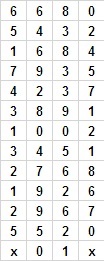 In the 1920s, the Russian neuropsycologist Alexander Luria began a series of experiments on Solomon Shereshevsky, who had a seemingly endless memory. Once he had studied a chart like the one here for about 3 minutes, he could recall it – reading up, down, backwards – not just for a few days, but for years! Shereshevsky was a synesthete, and for him numbers, letters and words were tinted with associations of colour, taste, shape etc which enhanced his recall. He might have had an amazing memory, but because his ‘memory filters’ were effectively switched off, he found day to day life very difficult because he found it impossible to sift out the constant conflict of associations attached to just about everything.
Aside from the fact that learning lists like these would appear to be pretty pointless, I suspect that most of us would look at both of these scenarios and think it unlikely that we could remember them – the main reason being, of course, that they are totally random.
Contrast this then with work done by Philip Ballard in the early 1900s, who conducted experiments on memorising Longfellow’s The Wreck of the Hesperus.
At daybreak, on the bleak sea-beach,
A fisherman stood aghast,
To see the form of a maiden fair,
Lashed close to a drifting mast.
In short, unlike with Ebbinghaus’ random syllables, he found that people’s recall actually improved at successive intervals; there is so much here of imagery and story that the brain recognises it as useful and so it is not assigned immediately to the trash!
So where is the musical application is this?
Whether notated music is written for a single line, or in the case of pianists and others, several notes simultaneously, in one respect it can be seen simply as a series of events.

On these three lines there are 110 note events. My question is this: How random are they? The answer is, undoubtedly, that these notes aren’t at all random, quite the opposite. To a young musician, however, learning a new piece of music, it is often the case that they don’t yet have the experience to place a new piece of music in context, and therefore much of what is before them might well appear, to them, to be random. Rather like the list of numbers above. Wow, imagine how horrible that would be: to go to a maths lesson and wade through all of those random numbers, in the knowledge that you are to be quizzed on them the following week… No thank you!
Somehow we need to be sure that we help our pupils to access the imagery, the story [theory maybe?] or whatever else they might need to help them to make sense of the notes in the piece of music which they are learning. Otherwise, perhaps it’s no wonder that, although we think we’ve spent time teaching them a piece, we sometimes find ourselves frustrated that they don’t seem to have taken anything in…..
 The benefits of singing in a choir are well documented. In the case of the ‘Choir who can’t sing’ my hope is that both the boys themselves, and those who hear them, accept that anyone can sing. I think it’s a strong message. My long-dreamed-of day when the whole school comes to Chapel and sings has arrived, and last Saturday the school sang Be thou my vision and In Christ alone with extraordinary energy. The choir has been part of changing the whole school attitude towards singing, and I believe that the school is much healthier for it.
 So, back to my piano pupil. I could instruct her, in great detail, to play each bar in a particular way – begin quietly, crescendo here etc – but who am I kidding? I know that this isn’t the way to draw out her musicianship. Worse, sadly, she might not know that; she could end up giving a very ‘musical’ performance and not have the first idea why – she’s just following my instructions. That would not be empowering teaching.
 georgebevan.com