Author Archives: georgeofmc

Sight-reading – are we making it up as we go along?

I am a keen chess player, but I wouldn’t rate myself as particularly good. My dad taught me to play chess when I was young – although I suspect that a more accurate way to describe it would be that he taught me how each piece moves, and to take care not to lose pieces too readily (although this still happens even now!) To be perfectly honest, I find the whole concept of teaching someone how
to play chess – that is, how to really play – a bit of a mystery. I think I’ve learned a few things over the years, mostly by trial, error and humiliating defeatchess pieces, and I’m still hopeful that the more I play the better I’ll get. But I have no doubt that what I really need is some quality teaching if I am to significantly raise my game.
When it comes to sight-reading music, I wonder how far different our approach is? Read the key signature, choose a steady tempo, keep going if you can. Perhaps with some (unhelpful?) comments along the way – “that should be F#”; “nearly; well done, keep going!” And probably the least helpful of all: “okay, not bad, let’s do some more next lesson.”

To make a significant difference to the level of our pupils’ sight-reading, two things need to be happening. The first is that it needs to be taught. We need to give our pupils plenty of strategies to help them along the way, so that they feel able to make progress rather than just struggling through yet another sight-reading test in the vain hope that it might be better this time. I believe that the real key here is understanding, and not at a superficial level either. Aural skills are also vital, so that the student can use her ears and her musical experience in addition to simply reading the notes; in my experience, once a student can hear the key signature, they are beginning to sight-read much more effectively. A clear understanding of pulse is critical, and if this hasn’t clicked with the student yet (forgive the pun), then this needs addressing first – without it, reading all but the most basic of single line rhythms is fraught with difficulties. Even the most simple of strategies can make a world of difference if we take the trouble to share them – take nothing for granted!

The second thing which needs to be happening is practice, and lots of it; the more you read, the more fluent you will become, especially if in the meantime there is good teaching taking place alongside. I will quite often hand a Grade 2 sight-reading book to a Grade 5-ish pianist with instructions to play through every test before next lesson – or even better, learn every test. It can be a huge confidence builder, and can also give us the opportunity to go back a few spaces if necessary, and point out some of the basic elements of the music. Simple harmonic patterns are generally easier to identify in the more elementary tests, and once introduced can really help musical understanding as things get more difficult. Easier tests can also be easier to sing, and if you can sing it, you can play it!

Teaching our pupils to sight-read is empowering, and yet we seem to spend a disproportionate amount of our teaching time on repertoire. Whilst the average 15 year old child might have spent x hours reading words, both in school and at home, it is worth considering how many hours that same child might have spent reading notes. For the average child, it is likely to be very significantly lower. We need to take this into account, and continue to take every opportunity to nurture their basic understanding of how music is put together – otherwise a huge gulf appears between what they can ‘perform’ and what they can actually understand and read.

How to practise, part 1

Over the past couple of months I have been immersing myself in the whole issue of music practice. I don’t have all of the answers, but I have had a few lightbulb moments, the first of which is this: just do something!

Inevitably there are always some pupils who will practise regularly, either because they are self-motivated or simply obedient. At the other end of the scale, there are some who just do nothing. It might seem obvious, but this group just aren’t going to make progress at all – how could they? So without even thinking about how effective their practice time might be, I have started at the bottom with the simplest of targets – do something… anything! This approach has a process driven outcome. In other words, success can be measured just by doing it. One of the most difficult issues with practice is that we have to address our shortcomings on a moment by moment basis, which I am certain must be the single reason why most people don’t enjoy it that much. But if the target is just to show up, get the instrument out of the case and blow down it for ten minutes, it’s actually going to be quite difficult to fail.

With this in mind, we now have a sign in book in our music department and pupils are asked to sign in and out each time they come in to practise. The same rules apply as above; some are keen and sign in like clockwork, and others won’t, or forget, or don’t see why they should. A few, after six weeks of term, don’t even know that the book is there….!

Now I did say that I’ve been immersing myself in this…? Each week I go through the sign in book and add up how much practice each pupil has done! It’s not an exact science by any means, but over the course of six weeks it has given me an extremely good idea of the practice habits of every pupil in the school, and they know this – and so do their teachers.

It has been a very enlightening experiment, and there are two things in particular which have become very apparent. The first is this: it puts practice out there, in the public domain. It is no longer a mystery, with teachers and pupils playing weekly games trying to ascertain or cover up how much practice has or hasn’t been done. Remember, we’re not yet addressing the content – just time spent. But with this sort of transparency, practice in on agenda and there is a clear message that everyone should be doing something.

The second is that it is clear to all that a sizeable number of students are really putting in the hours each week – and it is equally clear to me that the ones who put in the hours are the ones who are making progress. And it is good for our younger or less experienced musicians to consider whether our music scholars are just talented, or whether their success might also be due to the fact that they spend lots of time practising.

What is an arpeggio? do mi so warm-up

I often begin my piano/musicianship lessons with a little mental warm-up, and one of my favourites is this: I sing a note (do) and ask the pupil to complete the major triad, first with mi (the major third) and then so (the fifth). Although most students know full well what a major arpeggio sounds like, plucking one out of thin air, unaided, can be surprisingly difficult at first. This is a great way of developing inner hearing; I ask the pupil to imagine the sound of an arpeggio, or perhaps even to put their fingers over the keys and imagine playing it. Somewhere inside their head is that ‘sound bite’ of an arpeggio, and often is not so much that they don’t know the sound, but more a question of not being able to recall it. Once they have found it, I go on to sing a variety of different pitches and ask the student to sing mi and so above it.

do mi so

Once they have the hang of this, I move the goalposts by singing them so, and asking them to sing down the rest of the major triad, mi and do. This is more of a challenge; we are used to hearing/singing arpeggios from the root upwards, but not from the fifth downwards. Most find do first, and then fill in the gap with mi; with the more able student I will insist that they sing so, mi, do (in that order) which might mean doing some ‘sums’ in their head before presenting their final answer out loud. The ultimate challenge is for me to sing the third (mi), and for the pupil to find the root (do) and the fifth (so).

Most students are surprised to discover that a major triad consists both of a major third (from do to mi) and a minor third (from mi to so).  It is this element – learning to distinguish between and to pitch major and minor thirds, up and down – which makes this such a focusing exercise, and it’s what I like to call musical mental arithmetic. Arpeggios needn’t just be meaningless technical exercises – far from it in fact; adding this aural/theory/solfa dimension immediately gives them so much more value.

With a piano pupil this might be a three minute ‘game’ (fun eh?!), with a musicianship pupil it might lead into some sight singing exercises – after all, once we know where do, mi and so are, we have a strong internal framework for finding other notes; la is just above so, ti is just below do etc. Solfa is such a useful tool, and having used it now for the past couple of years in my teaching, I would never choose to be without it. Most noteworthy, if you’ll forgive the pun, is that at no point does either pupil or teacher even need to touch a musical instrument. In my book that is proper aural training.

Reading notation: Know it, don’t read it

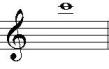
I have recently taken on a new piano pupil, and I was surprised to see that in several passages of a piece which he had been learning he had written the names above all of the right hand notes. Most of these notes were on leger lines above the treble stave, and he had evidently found these difficult to read – well they are more difficult to read aren’t they? 

Ledgerlines

However, what he had failed to notice was that the left hand was just an octave lower than the right throughout. Which means that he didn’t actually have to read the right hand notes at all. He could play it okay, but I just don’t think it had dawned on him that a little bit of knowledge (in this case simply ‘hands an octave apart’) was much more helpful than knowing the names of all those notes.

This is a classic case of being so concerned with reading the score that we forget to observe the glaringly obvious. When I pointed this out, he was equally bemused as to why he had written on his score!

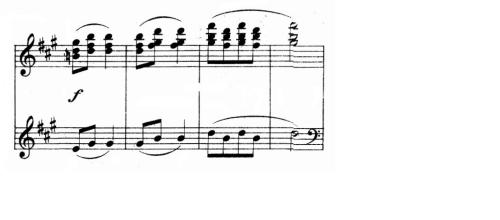
I set him a new piece to learn: To a Wild Rose by MacDowell. He did a brilliant job of learning it in just a week, but to my surprise he had written in all the note names in the right hand, just for a couple of bars.

wild roseHe was relying entirely on his reading skills to help him to recall these notes, and as already highlighted, leger lines aren’t his favourite! But there are other things which can help here:

  • we noticed that the bottom line traces a chord of E7, and the top line is also a succession of rising thirds
  • the first two bars have sixths between top and bottom notes in the right hand, and these extend to sevenths in the second two bars
  • the physical shape of the right hand chords, and in particular the different combinations of black and white notes, enable us to remember what they look and feel like.
  • a second finger on the B in the third bar gives a secure link between the alternating chords, again helping to forge a physical connection between the two chords

Taking a passage like this apart, and noting all of the musical, theoretical, physical and aural connections, will ensure that we really know it. And in many instances, our aural or memory skills might be better than our reading skills, in which case why rely solely on the reading skills? In short, we shouldn’t; we need to be prepared to use all of our musicianship skills, all of the time.

Reading notation: If you can’t say it, you can’t play it

When learning a piece of music – and when teaching a new piece of music – I always consider how I can make things as easy as possible, and this invariably means breaking the music down into tiny pieces so that every element is as simple as possible. For a pianist, that might well mean separate hands, but even beyond that it might be to break down each bar so that we can identify different hand shapes, finger patterns, harmonic outlines, interval relationships and so on. Paul Harris would call this making connections. This turns reading into learning.

When it comes to rhythm, this might also mean putting down the instrument and just dealing with the rhythm bit. After all, if you can’t even clap or sing the rhythm, or even just say it, then what are the chances of being able to play it on your instrument? Zero, I’d say.

Some of my pupils are quite surprised when I first ask them to take their hands off the keys and work at the rhythm by itself – after all, this is a piano lesson, and singing or clapping can be a little embarrassing! But they soon realise that actually it’s really helpful to know how the rhythm goes by itself, and that it’s a lot easier because they have less to think about.

Last week I found myself helping a pupil with a difficult rhythm in a Field Nocturne – 4 against 3. Having practised hands separately – the right thing to do – she had been trying her best to put the two together, but was frustrated that it wasn’t working. The reality was that she just didn’t know how the two parts fitted together.

IMSLP272546-PMLP24011-field_8_nocturnes_349854157

First things first; dealing with a complex rhythm and that mobile left hand accompaniment is just too much to cope with, so let’s remove the pitch element. In fact, let’s just take the piano out of the equation altogether and just deal with the rhythm by itself. I suspect that this idea doesn’t always occur to the instrumentalist, but it should.

Stage one is to work out how they fit together. They say that maths and music go together, and I guess this is what they mean! 4 against 3 looks like this:

4 against 3

Practise tapping left and right hands on knees until fluent.

Stage two, let’s sing the melody line so that we actually know how it goes, rather than just being able to play it – two very different things.

Stage three. A fusion of the rhythm and melody – but still no piano. We sing the right hand melody, and either tap the left hand rhythm, or better still, sing that too! So we end up singing the top line (down an octave, obviously) and doing our best to sing it in tune, and also saying/singing badly the left hand in the correct rhythm. Clearly it’s impossible to sing a two part piano piece, but in essence we’ll do our best. The most important thing is this: although the singing itself might not be brilliant, it represents what is going on in our inner hearing, and if it works in there, it will work on the outside too.

Stage four. If you can say it, you can play it! Now that the whole thing is mastered, we simply add the element of playing the notes.

In real time, this took about 10 minutes of the lesson, maybe 15. And in this time, we didn’t touch the piano. Does that matter? Not in the slightest, this is a music lesson. The best bit is that, having done the hands separately work already, it went together instantly, and I do mean instantly. With a huge smile!

Count me in!

This morning I gave a student a short canon to learn, and began by suggesting that he clapped the rhythm first, before trying to sing it. His attempt was pretty unsuccessful, and so I set about trying to work out what was going wrong. He could cope with crotchets and minims, but as soon as things moved to dotted notes and quavers it quickly fell apart – he appeared to be considering each note as an individual unit, rather than looking at the whole bar in the context of the pulse. In other words, counting 2 for a minim and 1 for a crotchet is fine, but how do you count 1 and a half for a dotted crotchet, or half for a quaver? I think the simple answer here was with difficulty, evidently!

canon

However, once I suggested that he tried counting the pulse aloud – 1, 2, 3, 4 – and then clapping the rhythm within the context of that pulse, his attempts were significantly better, and he went on to sight-clap (is that a term?) several other rhythms almost perfectly. Instant results! It seems that he has just been missing a tiny but vital hint which has now put all of his knowledge into a much more workable method.

Intrigued, I ran the same test on another pupil later on the same day, and with exactly the same results; she too counted the length of each note in turn rather than in the context of the pulse, and as soon as dotted crotchets and quavers appeared she went to pieces. I asked her how the counting went in her head:
“1-2, 1-2, 1, 1-2, 1, 1 er ….?”

As ever, the same question looms in my mind when I discover pupils with such glaring holes in their skill set – alarmingly both of these pupils are beyond Grade 5. How have they got this far without someone having fixed such an elementary issue?

I’d like to offer two answers to this question. The first might be this: because they disguise their weaknesses, either knowingly or otherwise, learning to navigate their way around difficulties by other means. In my experience, children can show all the outward signs of understanding something when in reality their understanding is far from secure! For instance, if the pupil has a quick ear, and the teacher is kind enough to play the piece first, the rhythm might not be read at all, just remembered. Handy for the student, but unwittingly we might actually not have helped them very much with that initial play through. To learn that piece maybe, but not to develop the skills to learn any piece.

The second answer might be that nobody has taken the trouble to fix it. How often do we ask our pupils to clap the rhythm of a piece before playing it? And much more importantly, if it’s not spot on, do we just ‘put it right’ – “it goes like this, now you try” – or do we actually dig a little deeper and work out how to help them to put it right for themselves. Telling is not teaching, but so often it’s a quick and easy way to get results.

Once again I find that Two-part hearing development, a collection of two-part canons selected by David Vinden, is a truly wonderful teaching resource. If a pupil can clap their way through this volume then I can be sure that I can count on their rhythmic security.

“Fun is a momentary thing” – Nicola Benedetti

I was very impressed by a recent article in The Daily Telegraph – No one is pulling Nicola Benedetti’s strings. Benedetti is a wonderful ambassador for music education, and the phrase that particularly struck me in this piece was this:

“The benefits of persevering are so much more than what everyone usually obsesses over, which is having fun. Fun is great, but fun is a momentary thing – it’s not something you can fill your life with, or that will sustain you through hardships. I wish this was vocalised in education.”

Well, I heartily agree! This is something which I believe to be a genuine problem in teaching our young musicians; not of Benedetti’s calibre of course, because although she cites her parents as insisting that she practised hard, I suspect that the driving force has always been Nicola herself. But with young people who are learning to play an instrument, but possibly don’t have aspirations to become a world class soloist, setting the sights appropriately is not always easy.

Who is responsible for setting those sights? Teacher, parent and pupil?

“We want his lessons to be fun” is perhaps a line which I hear all too often when parents request music lessons for their child. I like to think that they have just made a poor choice of word, and that “fulfilling” or “engaging” or “challenging” might be closer to what they actually mean. But reading Benedetti’s quote above, maybe they don’t! It worries me that they might actually mean “fun”, that momentary thing which although ….. well, fun ….. doesn’t really change much. It seems to me to be a strange factor to have at the top of the list of desired outcomes, especially when one considers the very real expense of individual music lessons.

Whilst I would hope that every teacher is consistently striving to raise their game, to engage and inspire their pupils at whatever level they are at, there is no question that without hard work and perseverance on the student’s part they are unlikely to make good progress. Students should not be going along to lessons each week expecting the teacher to do all the work, all the inspiring – that’s a pretty passive learning environment, if indeed it is a learning environment at all. I find that the most successful pupils are the ones who take responsibility for their own learning and who bring ideas to their lessons as well as leaving with some. Regular practice and perseverance also play a key part in the process, and these can bring a deep and lasting satisfaction. In short, hard work is where the riches lie!

Diploma – so what have I learned?

Several weeks have now passed since I took the dipABRSM diploma in Piano Performance. Results are not published until early in September*, and although I am of course eager to know how I fared, there is no doubt that I have learned a huge amount from this enterprise regardless of what the examiners say! Since it was undertaken largely as a professional development exercise, herewith some thoughts on what I have gained from the experience.

Before that, a little professional context lest I do myself some injustice. As an organist I won a scholarship to the Royal College of Music in London, and whilst there I won all the major prizes for organ playing, as well as obtaining an MMus in Performance Studies and the ARCM and ARCO diplomas. I am highly trained, and know how to give a first class performance. So my objective here was not to see whether I can pass a piano playing diploma, but rather to see whether I can give a 35 minute piano recital, under pressure, from memory.

I can. The principle thing which I have learned is that, given the right mind set, it is possible to achieve things which might otherwise seem well out of reach. If I’m honest I knew this already – but what I have realised is that this is a fundamental problem for some learners, and that many simply can’t get past I can’t. This is something which I hear all the time in the course of my teaching, and although I do my best to be sympathetic I’m afraid I don’t have much time for it! Arguably that’s what teaching is about – turning I can’t into I can – but the student also has to have the courage to set a new course. And it does take courage. And it can take time, and will often require a great deal of hard work and effort, and I mean a great deal.

I have lost count of the number of times that a pupil has told me, for instance, that they can’t sing the melody of their piano piece, but on realising that I am not going to give up asking they have eventually taken courage and gone on to sing it back perfectly! The I can’t here is just an excuse and not to be taken seriously – more like I won’t or I’m worried I’m going to fail so I’m not going to try. More often than not, from my perspective, the hard facts say that there is no reason at all why it shouldn’t be possible, which is why I tend to take on the dreaded I can’t rather than allowing my pupils to succumb to it. The best learners are those who take on their I can’ts and work out how to overcome them.

I’m not going to pretend that this diploma has not been a big deal for me, and the target which I set myself has not been an easy one to meet. With the music, the diploma exam would have been extremely straightforward, and for me, pretty pointless actually. Without the music, a new set of skills required and a great deal of work has gone into turning a dream into a reality; and having come through the other side I can now enjoy all sorts of new opportunities which were closed to me before. In fact, I don’t think it is an overstatement to say that this experience has transformed me as a musician.

But if there is just one thing which I will take away from this venture – apart from the extraordinary change in my own playing as a result of the freedom which memory allows – it is a renewed desire to ensure that my teaching is challenging. Not to be unreasonably demanding, but to ensure that our musicians are encouraged and taught how to make demands of themselves, to fight through a few I can’ts and realise that they can achieve amazing things if they have the right mind set.

[*Passed with distinction!]

Diploma progress

In January I stated my intention (see Fantasy Piano Recital) to prepare for an ABRSM diploma, and the five months since then has been the most amazing journey of discovery for me. Not all of it good, it has to be said, but a learning experience which has been hugely worthwhile. Some random observations…

My family have more or less banned me from practising at home, and my 11 year old son can sing my entire 35 minute recital note-perfect from beginning to end! I have always loved practising, and it is fair to say that this project has brought out some of my more obsessional qualities! However, I don’t think it’s all bad news; as a father, I guess I have been modelling commitment and perseverance to my four sons, and indeed in the last week my eldest (aged 17) has decided that he wants to apply to the Royal College of Music next year! And so the cycle continues….!

Apart from the Stravinsky, which I wrestled with largely unsuccessfully as a teenager, all of this repertoire was new to me in January, and I set out with the intention of integrating the memory aspect from the very beginning. In other words, rather than learning the notes and then working out how to memorise them, I deliberately set out to commit short passages to memory from the outset. The result has been that over the past few months I have spent more and more time practising with no music in front of me at all, to the extent that it has become entirely normal not to have it there.

Some parts of the repertoire have been much more difficult to memorise than others. The Schubert, for instance, is physically very ‘samey’ throughout, and the obscure key does not help – looking down, my eyes say B major, but the score says C flat major! And in the slow movement of the Beethoven it has been equally difficult to remember the subtle differences between very similar sections. On the other hand, some of the more technical passages (sequences in Bach and scales and arpeggios in Beethoven and Fauré) have been surprisingly easy to memorise, especially once the basic harmonic plan of the section has been established. The Stravinsky is so physical that actually the muscle memory seems to remain the most reliable method.

Whatever the methods, over the course of the past few weeks the entire programme has fallen into place, in as much as I have been able to play from beginning to end with increasing confidence, and certainly with no need to look at the scores. If anything, I have needed to make a concerted effort to open the music to check details of dynamics and phrasing as it has been months now since I have even looked at the dots!

The freedom gained has been truly wonderful. I have spent a great deal of time with a rather wonderful Steinway grand piano, and whereas in the past I have been content to sit at a closed piano and play the notes in front of me, I now open the lid and even remove the music desk so that I can hear the instrument more clearly; I listen more carefully. And now that the eyes are free, there are so many things to look at, to concentrate on. Fingers, fingers reflected in the fallboard, hammers hitting the strings, beautiful aesthetics of a fine concert hall, or nothing at all – eyes closed. I’ve experimented with them all, and the different focus which each one brings has been such an enjoyable experience.

Being without music has certainly sharpened my senses. Physically, I am now much more at liberty to see what I am doing with my fingers; watching the weight of the right hand little finger in the Schubert Impromptu makes such a difference to my focus. But this in nothing compared with how much the ear is switched on to sound!

So with less than a month to go, I took the plunge on Tuesday evening and performed to a real audience, my first solo piano recital in 26 years! I am an extremely experienced performer as organist, piano accompanist and conductor, but the single element under scrutiny here was whether my memory could cope with the additional strain of nerves. Getting fired up and excited about playing in a match can be hugely beneficial, but it is perhaps less helpful when you need to retain a vast amount of highly refined detail for a sustained period! The outcome – I really didn’t enjoy one moment of it, since I spent the whole time thinking “Don’t forget it, you’re going to forget it” and barely any making music. A schoolboy error? Yes!!

Not all is lost though, quite the opposite in fact. I think it was a necessary experience, and apart from anything else it has realigned my focus significantly. For although my own self-imposed target (not required for the exam) is to play from memory, the exam itself is neither a piano diploma nor a memory diploma – it is a performance diploma. Time to stop stressing about the memory and move on and up to the next level.

The other outcome is that this was a brilliant learning experience, not only for me but also for my willing audience, made up for members of the choral society and a few school colleagues and pupils. As a teacher, I think it is vitally important that they should see that I am still learning, and moreover that I am not afraid to show them that learning is not always easy. As ever, although the exam day looms larger and I want to do the very best that I can on the day, the process has been transformational, and will bear fruit long after the outcome (pass or fail?!) has faded.

Aural tests – just sing!

I have discovered the most wonderful resource for musicianship training – canonsSo much can be covered with the simplest of four bar canons, and perhaps the greatest beauty of all is that you need nothing more than two voices.

Take the following example:

canon3


The first objective should be to sight-sing the melody using solfa. I insist that my pupils do this, for two reasons. Firstly, it gives each note its place value in the key. And secondly, it is extremely focusing to be thinking about both pitch and syllable  – there is no room for passive participation here! Initially even a simple melody may prove quite testing, but this active engagement of the brain, this constant thinking ahead, is an excellent skill to be developing right alongside the aural skills.

Alternatively, or perhaps after an initial attempt at sight-singing, you can learn to sing it from memory, perhaps in two halves at first, but still using solfa.

With a more able pupil, you might dive in straight away and ask them to sing after you, in canon. This allows them either to read the notes as they sing, or else to memorize what you sung and follow that way – or ideally a combination of both. Still in solfa. They might get the notes right but a few syllables wrong – don’t allow them to get off lightly! Even if they get the melody perfectly correct, insist that the solfa is correct too, even if it takes a few more attempts.

And then there are the hand signs! These can be introduced whilst you are just singing in unison, and your pupil should sign too. The ultimate test, of course, is to sing the canon whilst signing the second part a bar later. But be warned, make sure you have practised this before you demonstrate in front of your pupil – it’s not easy!

A quick glance down the aural test requirements for the early ABRSM grades will show you just how much a little of the above covers:

  • Pulse. Singing together and in canon enhances an awareness of both rhythm and pulse.
  • Echo responses. Memorizing short phrases.
  • Recognising changes. Singing in canon requires careful listening to both rhythm and pitch, and students will soon be identifing their own errors.
  • Sight-singing notes in free time (Grades 4 & 5). The key here is solfa, and learning a few tuneful canons in this way will soon make the ABRSM tests seem insultingly easy.
  • Sing back a phrase. No problem – your student can now sing back a phrase at the same time as listening to how it continues!
  • Tonality. The place value which solfa brings (you just can’t sing mi without having worked out that it is the 3rd of the chord) is excellent for developing a sense of key, and singing in canon also encourages the student to listen carefully to the harmonies produced between the voices.
  • Singing back the lower/upper part. Once you have practised a few example, see whether your pupil can sing in canon without sight of the music; this really does develop their ability to hear one part and sing another.

I find teaching the ABRSM tests in order to pass the exam to be a pretty painful experience – but just learning and singing together a simple canon, even for a few minutes each lesson, is quite the opposite. Delightfully pure and simple, but incredibly focusing for both pupil and teacher alike. Let’s put the instrument down, or step away from the piano for a few moments, and sing!

This canon is the very first in a book of 109 canons selected by David Vinden in ‘Two-part hearing development” which is available here.

Plus …. a fab solfa video here!