Author Archives: georgeofmc

As easy as do re mi? A “beginner’s” guide to solfa

For as long as I can remember I have been able to sight-sing with confidence, doubtless due to my early training as a chorister and subsequent involvement with choirs for many years since. It still remains, for me, the most important thing for any musician – to be able to sing.

Three years ago I signed up for a British Kodàly Academy Spring Course. I can’t quite remember why, but one of the things which did interest me was the knowledge that the Kodàly approach uses solfège, the naming of each note of the scale as do, re, mi, fa, so, la, ti, do. I was interested to see whether there was anything in it, since I had my doubts – after all, I could sight-sing perfectly adequately without, so what possible use could giving all the notes funny names be to me? As I soon discovered, I was missing the point.

The first event of Day One was choir. We learned a song from memory by repeating back phrases sung by our director, which was challenging for one reason only – we were expected to sing in solfa! For me pitching the notes was easy, but remembering which solfa name to sing them to was not, and immediately I found my brain racing to keep up. And it was relentless! Just as I thought I had the hang of it, we cut to something different – learning another melody, or clapping and/or stamping a complex syncopated rhythm. And then (I should have seen it coming!) we put all of them together; melody, rhythm, others singing the countermelody, and the solfa! By the time the hour was up I felt like I’d done a day’s mental workout. They say that music uses both sides of the brain – definitely!
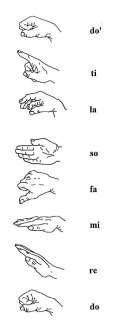
HandSigns

And then on to musicianship training. I was aware that there are different hand signs for each of the solfa syllables, but was not yet aware of their full potential. We learned some relatively simple pentatonic melodies from memory, and again the most difficult element was singing the solfa names. By now I realised that I was becoming much more actively aware of the relative position of each note in the scale, rather than just pitching each note from the previous one. The latter system still worked for the pitch, of course, just not for the name. Interesting. And then we were asked to perform a melody in canon. First at the piano; play first, and start singing a bar later (in solfa). Challenging, but manageable, and I have to say I felt very proud of myself for negotiating the task successfully, albeit with my brain running at full tilt. And then with hand signs. That’s right, sing first (in solfa) and then sign the canon a bar later with the solfa hand signs. “You’ve got to be joking” I said to Klara, the delightful Hungarian lady who was taking our class. Evidently she wasn’t. As encouragement, she performed the canon in three parts, using both hands, without even breaking a sweat! Respect.

Back in choir, I soon discovered that when the music changes key, do moves too – and so of course does everything else! Never before have I been so intensely aware of the place value of each note in a melody, and in observing every modulation as it occurs. I realised that much of the time I sight-sing on autopilot; yes, I am constantly listening, but perhaps not always thinking so hard. On the other hand, solfa actively forces you to listen and to analyse, and the intensity of this experience is actually very surprising. It is an amazingly powerful tool for teaching complete novices (as my Choir who can’t sing will testify) right through to analysing Schubert symphonies in detail, which I did on this year’s Spring Course.

This approach to musicianship is so refreshingly rigorous, and I love it!

Singing for pianists

The third of my five ‘E’s for outstanding instrumental teaching is developing an Enquiring mind. I think that it is vital that the teacher gets into the habit of asking questions rather than answering them, so that the student quickly learns that he is expected to work things out for himself. A simple example: “don’t forget the E flat in bar 5” becomes “which note did you play wrong in bar 5?” It is so easy to fall into the trap of giving the answers, but telling is not teaching and we should not be in so much of a hurry to teach a piece of music that we forget to teach the student.

Assuming the student answered the question correctly, let’s make the next question a little more difficult: “Can you sing me the E flat please?” At this point, in 9 out of 10 cases, the student will reach for an E flat on the piano – if they get the chance that is, because I’m ready for them! “No, don’t play it, sing it.” For me, this really gets to the crux of the problem. Sitting at a piano is like having a calculator in an arithmetic exam, but easier; if you want to know an answer, just press the relevant key and the answer is immediate.

At the simplest level, this is going to test the student’s aural memory. Can they remember, in their inner ear, any of the notes which they have been playing in the last few moments? The questions which they need to ask themselves are going to be the equivalent of a mathematician showing how they reached the answer – if they think that you are just expecting them to pull an E flat out of the air then of course they have every reason to panic!

A few more leading questions might help; “The phrase started on a B flat, can you remember what that sounded like? Yes? Well, can you sing me a B flat then?” Once they have sung the B flat, a little theory might be required: “How far away is E flat from B flat? Ok, sing up a four note scale from the B flat and we should get there!”

My piano pupils are used to this type of questioning, resigned to it perhaps! They realise that I am serious, however, and although in the early days some will just dig their heels in and refuse to sing – I had a pupil once who took weeks and weeks even to pluck up the courage to proffer a single squeak – they all know that it is an expectation. The benefit, of course, is that they are using their ears, and they soon realise that it can be quite helpful to have their ears connected up with what their fingers are doing.

This style of teaching encourages the student to use their brain, their memory, their ears, their knowledge of theory, their voice …. and sometimes diversionary tactics! The alternative “don’t forget the E flat in bar 5” seems unhelpful in comparison.

Effective practice – a must read!

I have recently discovered this amazing blog post, entitled How many hours a day should you practise? by ‘The Bulletproof Musician’ which encapsulates everything that I think it important to appreciate about how to practise effectively. Particularly good sections entitled Mindless and Deliberate practice. More eloquently put than I could ever manage, and a must read for any student, parent or teacher.

Musicianship

I think of myself more as a musician who plays the piano, rather than a pianist. I’m more interested in the music itself than the mechanics of it.   Martin Roscoe                                                            

I was delighted to hear Martin Roscoe say this in a recent interview, since it mirrors almost exactly my own sentiments when it comes to teaching. A quote from a blog post of mine from just a few months ago:

I find it very helpful to think of myself first and foremost as a music teacher, but one who just happens to teach that musicianship through the piano.

Sadly, unlike Martin I don’t think that I will ever reach the point where I will be able to let the ‘mechanics’ of playing the piano take care of themselves! But let’s get back down to earth and summarise:

It’s about the music.

A good proportion of my piano teaching is concerned with forming a solid technique. The purpose of the technique is to serve the music effectively, so that the pianist is able to express their intentions at whatever level they happen to be performing. I am also passionate about the mechanics of learning, and in particular in how to transfer the skills necessary for a pupil to become self-sufficient.

But what happens if the student just isn’t very musical? The answer is stunningly obvious  – we need to draw out their musicianship. I really can’t see the point of teaching the mechanics if the musicianship is neglected, since the student will have nothing to communicate if they have no musical understanding. And yet I find myself, on a daily basis, encountering young musicians who are ploughing through the ABRSM/Trinity grades with little understanding of the music which they are playing because the focus is too much on the mechanics, and not enough on the music itself. I am not talking about instructing pupils how to play musically. No, it is about drawing out an understanding so that they know for themselves how to play musically. The difference is vast.

Since coming to Monkton some three and a half years ago I have done a lot of work with ‘non-musicians’. The tone deaf project and The Choir who can’t sing are clear indications to me that to write off the ‘non-musician’ is a serious mistake. I am also convinced that the way forward is to train the musician first, because this the the bit which lasts. In order to do this, the focus needs to be on musical things – aural skills and inner hearing, understanding the implications of harmonic progressions etc. If that means going a little slower with repertoire in order to further the musicianship of the pupil, that shouldn’t be a problem!

How much can you achieve in half an hour?

My first piano teacher, Ethel May, was a little old lady who lived on the other side of town. She had a fine reputation as a teacher, and I suspect that a large part of the success of her pupils was due quite simply to her expectations when it came to practising; when she took me on, aged six, it was on the clear understanding that she would only teach me if I practised for half an hour every day.

I am reliably informed (by my former practice coach – thanks Mum!) that I used to do my practice in two 15 minute sessions every day. Thinking back to my first piano book, and those first few simple pieces (with thumbs always over middle C) I am struck by how much I must have been able to achieve on 3 hours a week! With that amount of time, I must have arrived at each lesson having played those little pieces hundreds of times, with time to spare to lovingly choreograph each finger movement, and doubtless to memorise the notes too. I really don’t remember, but I suspect that by mid-week I must have been ready to turn a few more pages and forge ahead by myself, having had more than enough time to master the work set.

Many years on, I have never found it too difficult to guess how much practice my pupils have (or haven’t) done each week. There are lots of clues, ranging from seeing the music falling open to the right page – in contrast to the pupil not even knowing which page their piece is on – to noting whether they can start playing straight away or whether they have to work out what the notes in the first chord are before they can even start!

What I am completely confident about, however, is that half an hour a week is not enough. For anyone learning any instrument at any level. After the lesson which I taught this morning, I am confident that my pupil (working towards Grade 7) has all that she needs in the understanding and technique departments to completely master the passage which we were working on; the only other component which now needs to be thrown into the mix is Time. If she spends half an hour every day on it, she will know every little moment – the note which she always forgets (D flat!), the differing chord weighting required in the right hand accompaniment, the left hand chord sequence and associated finger patterns – she can’t fail to. But on half an hour a week (that’s just five minutes a day) she might have had a chance to play through the passage a few times, but the familiarity will simply not come in that time. Time and practice is what is needed.

In a busy boarding school environment, I think it’s probably quite easy to slip into the “she’s got so much else on, so I ought to be pleased if she can manage to practice for an hour a week” mentality. On reflection, I just can’t see how this works, and we are deceiving our pupils if we fall into the trap of allowing them to believe that ‘not much practice’ is okay. On the other hand, half an hour a day + good teaching will ensure excellent progress; personally, I’d read that as a bare minimum.

[As an after-thought, I did some sums. We currently teach 208 music lessons each week. If each pupil practised for half an hour a day, that would generate 104 hours of practice every day; with 12 practice rooms available in our wonderful new music department, that would guarantee full use of each one from 8.45 until 5.30 every day. That would be amazing!]

Sight read no jumps

I was fortunate enough to gain a place as a chorister in a parish church at the age of eight, and received five years of the most wonderful musical training. In fact, there was a series of very specific tests which we were expected to work through, and success was rewarded with a coloured drawing pin on a chart. Wow! (Actually, I was hooked from day one!)

stMary's1980

More specifically, there were 7 blue, 15 red, 5 green and 5 purple tests. The blue ones were along the lines of ‘read a hymn’ (Immortal, invisible, God only wise,
In light inaccessible hid from our eyes!), sing a scale G to G etc – all things which a seven/eight year old needed to get to grips with if he was going to progress to becoming a ‘full chorister.’ It was a very simple system, but the tests became increasingly demanding – I can’t remember what any of the purple ones were, but they were probably along the lines of ‘process down the nave of the church with a candle in one hand, whilst sight-reading the alto line of Stanford in G with the music upside down!’

However, I do remember several red ones, including ‘sight-read no jumps’. Our assistant choirmaster, Mr Baker, would draw a stave, a treble clef, and a major scale from middle C to top G, on the back of a scrap of paper. All that was required was to be able to sing up and down the scale, by step, as he pointed to each note, but changing direction occasionally. The aural equivalent of going up or down a ladder, one rung at a time. Looking back, we must have learned

  • the ‘sound world’ of the major scale
  • where the tones and semitones were
  • that next door notes move either from line to space, or from space to line

Not too tricky once you got the hang of it, but nevertheless something which needed practise and familiarity. Sight-read jumps, on the other hand, was fiendish, and the test board, all neatly organised in rows and columns, had a notably empty column under this heading – the few boys with a red drawing pin at this point were held in great esteem, and quite rightly! In short, if you can do this, you can do anything, and I do mean that quite sincerely.

Sight read no jumps is not difficult, but I believe that it is necessary for all musicians to practise it and master it. I regularly encounter young musicians (and also older ones) who quite simply can’t sing from one note to the next. I find it difficult to allow them to justify why not – scales are the alphabet which we work with, and we must have a basic working knowledge of the scale. They might not like it, but when I ask my piano pupils to sing a musical line in lessons, they know that I’m serious and they just get on with it. After all, the ears need just as much training as the fingers.

Are you answering the right question?

According to Daniel Kahneman, when posed with a difficult question, we can have a tendency to substitute an easier question and answer that one instead. Without noticing!

questionmarkIf that sounds unlikely, consider the way in which some children tackle their music practice. “I still can’t play this section, so what am I going to do to solve the problem? I know, I’ll practise it slowly (like my teacher has told me to!)” This student might be praised for having a considered approach to his practice, and also for following his teacher’s advice. The trouble is, if as a pianist he has chosen poor fingering which really doesn’t work, no amount of slow practice is going to solve the problem. Sadly, what he has actually done is find a much easier answer to the wrong question.

I have written before on the subject of developing an enquiring mind, which I believe to be vital if our pupils are ultimately to stand on their own two feet as musicians. To practise effectively, students need to learn not only to ask questions, but to ask the right questions, time and time again.

I find it helpful to consider all of the potential decisions into an imaginary flow chart, which might include questions such as:

  • Does this passage need work?
  • Where exactly is it going wrong?
  • What, exactly, is the problem – wrong note, technical issue etc
  • Can I try something different?
  • Does this new method make it better, worse, no difference?
  • Have I fixed the problem now, or do I need to find some more questions?

The point is that just one question – “is it getting better?” – is not enough. The right question is “how do I improve it?” – this question has the potential to generate many more questions and even more answers. And it takes ‘effortful mental activity’  (‘system 2’ thinking) to ask these, and even more of the same to ensure that the correct solutions are pursued. Our pupils need to realise that the decision-making required here is constant, and we need to be modelling this for them constantly too. In short, practice is demanding, but with this degree of purposefulness it can also be extremely rewarding.

We need to teach our pupils to think like this. I often tell my pupils that I consider that my role is to teach them to think, not to play the piano! That’s not strictly true, but actually the ability to think for themselves will be far more helpful to them than just knowing how to play a piece of music. How much do they gain if I, the teacher, am the one who has worked out for them how to solve all of the potential difficulties along the way? Very little I think. Once a student knows how to make constructive decisions which can guide their practice so that it is productive, they will fly –  and not just in their musical studies but in everything, since these skills are of course transferable. And we are being told that Music is not an ‘academic’ subject – how ridiculous.

British Kodály Academy Spring Course

From 2-5 April this year, the British Kodály Academy will be holding its annual Spring Course. There is a wealth on information on their website, which this year is aimed specifically at conductors and singers. 4 April includes a concert given by the London Adventist Chorale. I attended the course two years ago, and for me the daily musicianship lessons were the undoubtedly the highlight. The Hungarian tutors in particular bring a very different view to musicianship training than anything which I have seen before, and those few days not only inspired the tone deaf project and the Choir who can’t sing, but have had a long lasting effect on all aspect of my teaching ever since.

BKAI am a huge fan of the Kodály Method, at the centre of which is an emphasis on the development of our inner hearing; that is, the ability to hear notes or music inside our heads without the need to play or sing.

When I first learned to read, I remember very well having to say the words out loud as I read them. My twin sister, on the other hand, had by this stage already learned to read the words silently in her head. [She was also way ahead of me when it came to tying shoelaces!] At the time this was a difficult concept for me to get to grips with, and I had genuine difficulty in believe that she could actually read in this way! Now, with years of practice behind me, and like many other people, I guess I take it for granted.

Read this sentence out loud: “It ought to be no surprise to you that, on reading this sentence out loud, it sounds just the same as how it sounds in your head when you read it silently.” Now imagine how strange it would be if you didn’t actually know what the words sounded like until you read them out loud.

But this is exactly what many students do when it comes to music – they have little or no idea what the notes will sound like until their instrument produces the sound for them. For me, this is all the wrong way around! The instrumentalist should be able to look at the score and be able to hear the sounds on the page – and then when they play, the notes which sound come as confirmation of what they expected, and not as a complete surprise: “Oh, that’s what it sounds like!”

The implications of this are far-reaching. How does a violinist know whether she is playing in tune if she has no idea of what pitches she should actually be playing? Without inner hearing, she has no point of reference. How does a student know, when he is learning a new piece of music, whether he is playing it right or not? If his only point of reference is having his fingers in the right place, where is the musician in this process?

I guess the big question is this: Would you like to be able to look at a piece of music and be able to hear it, inside your head, in the same way as you can with words? If the answer is yes, then a Kodály course is for you! This is a skill which can be learned, in just the same way as we learn to read silently. Not in five minutes, or even five days, but it is something which our young musicians should be learning, and can learn – all of them. And even some older ones too. It isn’t a mystery, or some gift which some have and others don’t – it is a skill which comes as a result of some serious hard graft and determination. It is also, in my opinion, the best skill which any musician can possess. And it is, of course, empowering.

Note-learning – why we don’t like it!

In his book Thinking, Fast and Slow, Daniel Kahneman presents the idea that we have two systems for thinking – System 1 is effortless and intuitive (fast), whilst System 2 relies on deductive reasoning (slow). Although I have not yet finished this extraordinary book (which appears also to have some leanings towards economics, which is most definitely not my field), this concept has been a revelation to me in terms of the light which it might shed on studying music, and in particular on how we practise.

In recent weeks I have asked many colleagues, friends and pupils to answer the sum 17 x 24, out loud. Several have declined even without trying: “I couldn’t do that.” Eavesdropping on others whilst they have multiplied, stored and carried their way to the answer (not always the right answer!) has been very enlightening; there is no doubt that mental arithmetic requires our undivided cogitation, even for the few who took on the challenge with no fuss. Kahneman’s suggestion that our System 2 is essentially ‘lazy’ seems to me to carry a lot of weight – most people would rather do something which comes more easily!

Is it any surprise then, that given the prospect of learning new notes, many pupils conveniently find something else to do instead?! Note-reading requires  a great deal of mental effort not only in reading pitch and rhythm, but in co-ordinating the body and at the same time trying to assess, via ears, fingers and intellect, whether we have it right or not. Having opened the score, some pupils will find it hard even to begin, whilst others might make a reluctant start but give up once they realise the scale of the task ahead. Maybe perfecting the first page would be more fun after all…!

For a long while now I have encouraged my pupils to think about three stages of practice. Stage One Practice is note-learning.  However reluctant, just a few new notes learned every day will make in-roads into the piece which the student is learning, as well as practising reading skills of course. Stage Two Practice is consolidating our recent note-learning. Once we are familiar with something, even if we only encountered it yesterday, we tend to regard it with less suspicion! Music which was new yesterday is altogether more approachable today. Stage Three Practice is refining music with which we are now quite familiar, and might even be considered playtime!

Stage One Practice is, of course, System 2 stuff – that is, hard work on the brain. By the time we get to Stage Three Practice, however, we are moving very much more towards relying on our intuition. Expert intuition can be learned, in as much as we can become so familiar with something that we just know it. Once at this level, the tough cognitive work is behind us, and things come easily. Don’t be fooled into thinking that Stage Three Practice is easy – far from it – but in pure cognitive terms it is less demanding than the early note-learning stages.

Just being aware of this concept is surprisingly helpful. I actually like learning new notes, but sometimes, especially if I’m tired, I prefer to work on more familiar repertoire. And with some students, knowing that there are aspects of practice are potentially very demanding might alter the way in which we approach helping them; sometimes it’s not just a question of time spent, but actually breaking through the initial mental barrier to take it on at all.

In the wider context, pupils who develop the habit of learning new notes every day, and are therefore readily prepared to think hard and problem solve, are surely more likely to use these transferable skills in other areas of their learning too. It strikes me as an excellent habit to be cultivating.

Fantasy Piano Recital

As a piano student, I was never taught to memorise music – in my ignorance, I think I just assumed that it was something which you could either do or you couldn’t, and since I couldn’t, I didn’t. I suspect that I was also guilty of going to piano recitals  and singularly failing to observe what I now believe to be an extraordinary feat, that of memorising a whole recital programme with apparent ease. This, coupled with the equally extraordinary technical and musical mastery which the world’s finest pianists also command, makes me wonder whether the sharing out of gifts sometimes seems a little unfair!

With this in mind, a recent article in The New York Times, which suggests that playing with the score is more acceptable these days, couldn’t have come at a worse time for me! For me, being a real pianist means all of the above, and having just discovered (okay, perhaps a little late in life!) that actually I can memorise, I don’t need to hear just now that maybe it’s not so important after all.

Learning to memorise is difficult, and requires a methodical approach with reference to the technical, aural, harmonic and visual, to name just a few of the many strands which come together to form a system which is utterly reliable. Plus determination, self-belief, perseverance, time and a great deal of hard work. I am not for a moment suggesting that pianists who play with the music are not able to convey great musicianship; it’s just that I am looking for that artistic freedom which comes from knowing the score completely. And if it proves difficult? I’ll find a way, but can’t is not an option for me. [link here to an excellent blog by Mel Spanswick on the same subject.]

In order to force my own arm on the issue, I have set myself the challenge of preparing for an ABRSM diploma this year. Candidates are required to give a 35 minute recital; memory is not a requirement, but I am adding this self-imposed element to the challenge. My ultimate objective – to be a better pianist. And along the way I am increasingly awed by those pianists who hold so much music in their heads!

He is my proposed recital programme:

Bach Prelude & Fugue in g minor (Bk 1), BWV 861
Beethoven Sonata in c minor, op.10 no.1 complete
Schubert Impromptu in G flat, D.899 no.3
Fauré Impromptu op.31 no.2 in f minor
Stravinsky Piano-Rag-Music

To help in my preparation, and in particular to gain further insights into possible interpretations, I would love some ideas for a Fantasy Piano Recital. Please feel free to nominate your preferred pianist for each of the works above ie. Bach – Glenn Gould, Beethoven – Barenboim etc. I look forward to hearing your ideas.


[subsequent progress reports here and here!]