
As I’ve said before, I have come to the conclusion that there are three things which are vital in order to be able to sing well. These are:
critical listening [ears]
good breathing [voice]
confidence [mind]
Last term I took on the challenge of teaching a young member of our sports staff to sing. She revealed over lunch one day that not only could she not sing, but that she was terrified of singing. I found this hard to believe – she seemed like the confident type to me! So it was with great surprise, when she came for her first lesson, that I discovered that she really was completely traumatized even by the prospect of singing, to the point where she was reduced to a quivering wreck. Genuinely so. I won’t forget that lesson, ever.
 Over the coming weeks we coined the term ‘humming lessons’! It quickly became apparent that our main difficulty was simply going to be able to get her to make any sound at all, never mind dealing with any pitching issues. And when, eventually, she managed to hum a note, it became clear that her ability to pitch was as bad as I’ve ever encountered (that’s bad, by the way). Wow, what a project!
On the whole, without practice things don’t get better. Using a knife and fork is tricky at first. And if as a trumpet player your tone is a little rough, it doesn’t actually get any better unless you practise regularly. And if you haven’t sung for the best part of *15 years since being publically humilated in front of the rest of the class in Year Five, you won’t have had much practice at pitching notes accurately.
Several months ago I was contacted by Christopher Sutton from EasyEarTraining.com, who was planning on designing an app to help people to sing. He had encountered our Choir who can’t sing project on my blog, and wanted to tap into my experience. I had my doubts; after all, probably the biggest part of this whole initiative depends on me! The whole confidence thing is tackled by me getting alongside each individual and saying ‘Come on, I believe you can do this!‘
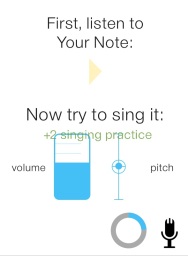 Enter SingTrue, launched next week for iPhone/iPad, and in a word, brilliant! No surprise that there are three modules – ears, voice, mind. I have been amazed (and flattered) to see so many of my little teaching tricks – and those of others too – incorporated into this clever piece of software. I’ve been been playing with the app for the last few days (official release date 21 October) but it has suddenly dawned on me that there is one potentially huge problem with my teaching; me! I’m there, in the room, with my pupil. And therefore the whole confidence element is a problem. In many instances it’s not insurmountable, and in fact most boys just get on with it. Girls generally find this more difficult though, and in the case of this pupil, I realise now that I was getting in the way! I think this is a great app. I wouldn’t want to be replaced by an app, but it does allow those who’ve had no practice to have a go, without fear of being heard by anyone – however encouraging their teacher might try to be.
*Insert your own number if this story sounds all too familiar. Sadly, I often encounter people, many in their forties or fifties, who have never sung because they were told as a child that they couldn’t. And so they haven’t 😦
[August 2017 – staggered to discover that apparently 450,000 people (!) have ‘found their note’ using Singtrue]
 whether children think that pitching notes is some sort of unfathomable mystery! How should I know where that note is? Well in maths we have systems for working things out, which we are hopefully taught from an early age, and which we then have drummed into us for years to come. 12 x 3 = 36. I happen to know that one now, but if I do forget it I have various strategies for working it out; on my fingers maybe [I call that Mostyn maths, but that’s another story], or in columns on a piece of paper or visualised in my head. So when I ask someone to sing the A above middle C, I’m not just expecting them to pluck it out of the air. Someone with perfect pitch can. Or else someone who knows their theory knows that C up to A is a major 6th, and remembers that’s the tune to ‘The day thou gavest’ – they can do pitch it too. Or someone who can sing up the major scale, rather like moving up successive positions on a number line; they can find it too.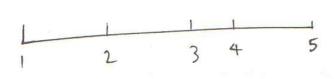
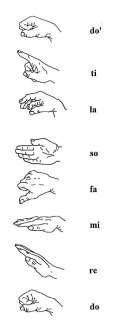
 Singing back the bass line is not a problem for her. She can sing just about every line in every piece which she has learned, so why should a simple Grade 8 aural test phase her? Not only that, but when we learn a new piece, she fully expects to be asked to sing the melody whilst she plays the bass line, or the other way around. From memory. Well why not? It’s not easy the first time of course, but five years down the line it has simply become a skill which she has developed and now takes in her stride. Having memorised sonata movements by Scarlatti and Beethoven, and a harmonically complex Brahms Intermezzo, how hard can a simple tonic/dominant bass line be?



 georgebevan.com