Category Archives: teaching

The Emperor’s New Clothes

The word performance, to me at least, means putting on a show. In theatrical terms, it’s an event which happens on stage, under lights, to entertain, to impress, to enthral.

What we don’t want the audience to see is all of the stuff behind the scenes: the heavily-annotated script dropped moments before in the wings, the director barking instructions into headsets: “20 seconds until scene change!” And we most definitely don’t want to know the human story behind how we have arrived at this point – the hours of learning, perhaps tears, the moment we nearly decided to throw in the towel altogether. No, a performance is exactly that – a show, a charade even, where we disclose only that which we want the audience to see and hear. 

As a career schoolmaster I have spent countless hours in the exam room accompanying young musicians in every imaginable scenario from ropey grade 1 violin to effortless grade 8 French horn. Despite always having sought at the very least a quick run-through beforehand, there have of course been plenty of candidates whose counting (or lack of counting) has let them down, at which point it falls to me to stick with them and do my best to cover up any bumpy moments. We are, after all, giving a performance, and we don’t want our audience (in this instance the examiner) noticing anything untoward if we can help it! Not to discredit any examiners, but I don’t think anyone will disagree that a decent accompanist can add a little performance glitter and might occasionally be able to deceive their audience to the benefit of the exam candidate. It’s a performance, that’s what we do. We only show the stuff we want our audience to see.

The trouble with performance exams is that education is about teaching children how to do things which they can’t already do. In other words, we need to be able to see, to talk about, to examine the things which we can’t see. All of that back-stage stuff – the paint pots, the broken props, the tears, the tantrums – that is education happening right there. That’s the bit we need to be focusing on. If you only get to see the actual performance, you are just the audience. You have no idea about the performer and how they reached this point because the performer’s very purpose is to disguise this information from you. You have played no part in their ‘education’. You can only judge what you see and hear – it was a show.

The UK exam boards will defend their position until hell freezes over, telling you that they’re examining a different set of skills. ‘Communication, interpretation and delivery, musical continuity, stage presence…’ This generates so many questions in my mind, but the ones at the top of the list are:

If you’re looking for ‘communication, interpretation and delivery’ now, what on earth have you been looking for in the three pieces in all the exams held since 1880 (give or take a few years.) It actual defies belief that we are expected to fall for this…

Stage presence, in a video exam? You must surely be joking. Quick rewind to the first paragraph, teacher standing ‘in the wings’ just out of shot gesturing wildly to the candidate to *smile/relax/stop crying, it’s only the fifteenth take and if you get this one right we’ll call it a day (*delete as appropriate)
This leads to another question: has anyone else wondered why the ‘performance’ exam is not available as a face-to-face option? I’m serious, ask yourself the question, and then ask yourself whether you think this format is in the best interests of our young musicians and their musical education, or just suits the convenience of the exam board. Or whether it just hasn’t occurred to them yet, post-COVID, to offer this format face-to-face? Of course, in the case of at least one of the UK exam boards, all but one of their diplomas are now available only in recorded format. Incredible, you can attain a Fellowship diploma, in performance, without ever having performed live to a single person. The Emperor’s New Clothes indeed!

But my main questions are these. In the context of an exam board offering a performance exam, what exactly have you done to encourage the education of this child? What have you done to support the huge number of teachers in this country and beyond who look to you to give them a lead and help them to do the best job that they can? The short answer is that you haven’t: you just arranged the performance and now you’re sitting in the audience.

From an educational perspective, these ‘performance’ exams do little to support our young musicians and their teachers. In fact, they are doing the opposite – yes, dumbing down – by pretending that the performance is the main event, when actually it is the teaching which is where the focus needs to be. And yes, they will feed you the usual line about teachers having the freedom to teach all of the other things in their lessons – you know, the important stuff like literacy, musicianship, those things. But here’s the thing: they don’t. These examining bodies, whilst claiming to support the musical education of our children, are shouting loudly about an assessment system which is focused entirely on the performance, the show, the façade. They call it ‘playing to the candidates’ strengths’. I call it ignoring their education. Worse, they’re pretending that this is their education.

These UK exam boards have rightfully earned huge respect in their field over the course of the last hundred years and more, but with that comes responsibility. Their introduction of ‘performance’ grades, to the detriment of the actual education bit, sends a very loud signal to teachers, parents and pupils alike, many of whom still believe that what they are selling is of value. It says ‘take the easy route’. They want to have their cake and eat it; they’ll tell you that teachers are still at liberty to teach sight-reading etc, but then they flood the market with a product which undermines any credibility for an organisation which claims to support the learning of our young musicians.


Upgrade vs the perils of cognitive strain

How would you fancy a new ‘processor’? An instant upgrade, which gives you the ability to read music at x3, x5 or even x10 your previous capacity. Sounds good eh?

I had a wonderful break-through with a piano pupil towards the end of last term. He is a fine musician and clearly loves playing the piano, but he is also a classic example of a student who enjoys playing, but not so much the work involved in getting there!

He is very bright and is not afraid to read, and perhaps surprisingly, therein lies one of his weaknesses; he reads everything, all of the time, until such point as the music is ‘in the system’ and muscle memory has taken over. In itself the reading part is fine, but it’s hard work on the brain, reading all that data all of the time, and this is the part which he doesn’t enjoy. My teaching focus with him has always been to find ways to engage his intellect, so that the practice process itself becomes interesting and challenging to him, rather than just a chore to be accomplished. To quote Daniel Pink (Drive, 2009) “The joy is in the pursuit more than the realisation. In the end, mastery attracts precisely because mastery eludes.” 

So how about that upgrade then?

We have been working on the final movement of Beethoven’s Piano Sonata in E major, op.14/1. Having asked him to prepare a section of the movement, I was disappointed to find that he had come back, as ever, able to play the notes, but not really having learned them; and not just that, but complaining that he just couldn’t get excited about having to learn all those notes. I’m not surprised – once the cognitive strain sets in (and it doesn’t take long) it’s not much fun.

beethovenop14no1

So how about using another resource in addition to reading; memory perhaps? Bar 58 is in b minor, and it really is just arpeggios. Let’s look at the detail: the first falling arpeggio shape starts on F#, and then it’s just three more falling arpeggio groups, all starting on B but an octave lower each time. The final one rises again. There are 25 notes in these two bars, 25 bits of data. But we can reduce that to 5, at most.

Bars (60-61). The bass falls by a step (and indeed that pattern continues through to bar 66). What kind of chord is this? A dominant seventh on D – but note that the fifth (A) is missing. Apart from that, it’s the very same shape as bars 58-59, and even starts on the same note, F#. Nice pattern 🙂

And then bars 62-63. G major [perhaps not surprising following the D7 chord.] The same shape as before, so all we need to remember is that the RH starts on a G. Bearing in mind that everything else is the same as bars 58-59, I’d go so far as to suggest that these 25 notes can be reduced to ONE detail only; the RH starts on a G. Bars 64-65 is another dominant seventh, as before with the fifth (F#) missing.

These eight bars have now become an intriguing memory game. There may be a little bit of thinking still to do, but nothing like the cognitive strain required to read all of those notes at speed; in fact, we’ve opened up an entirely new set of skills. No reading needed at all, which incidentally frees up the eyes to see some of those patterns which we’ve found. The joy is, it has taken him all of about 5 minutes to take all of this in, it’s engaged him fully, and the work is done! And now he’s keen to continue into the next passage and apply the same method.

footnote
The key here is in actively looking for patterns, and without a working knowledge of theory a student is never going to unlock this upgrade. ABRSM may have dumbed down their grade 5 theory exam of late, but the requirement to pass it in order to progress onto the higher practical grades remains very sensible. Teaching theory needs to be an integral part of every instrumental lesson.

*footnote to footnote
Over the past few weeks the change in this student’s learning is so evident. He has moved from reading to actively seeking patterns, and he is now using his memory as an active strategy rather than it just being a passive by-product. Upgrade most definitely achieved!

Practice: New tools

I have just stumbled across an old blog post on practice. There are many reasons why our pupils don’t practise – busy school lives and mobile phones being the ones which spring quickly to mind – but I still believe that the biggest problem is when practice feels like a waste of time because it doesn’t seem to make any difference.

I often find myself explaining to a pupil that the practice technique which they used when they first started out – the “play it over a few times and it will get better” method – just doesn’t work any more. It was fine when their pieces were maybe a single line consisting of a few crotchets and minims, but now that they are playing music which is more complex, the “have another go” approach is simply no longer effective by itself. They need more tools.

“How are you going to practise this bit?” is a question which I ask in every lesson, often more than once. Not an instruction, “practice this bit.” It’s a question – “how?” Not delivered in a way which demands a correct answer, but rather an invitation to share ideas, together. Perhaps it’s “what could we do here?” – we need them to know that we’re just as interested in solving the problem. What we are not doing is putting our pupil on the spot and insisting that they give us a correct answer; that’s not going to help!

The difference between an instruction and a question at this point is critical, and has the potential to change the entire teaching/learning environment there and then. Because we are about to get a glimpse inside our pupil’s head, and see exactly what tools they have at their disposal.

Often the first response is that they’ll play it over a few times and hope it will get better. Notice the hope – the lack of assurance might be a hint at their underlying fear that it might not make a difference…

Ok, and what else could you try? Scarily, some students are already out of ideas, but most will come out with well, I could play it slowly. Excellent, and how does that help? If your student now draws a blank, don’t panic – this first venture into their practice world has already been extremely worthwhile! But we’ll need to ask ourselves, how on earth are they going to use their own time constructively if this is all that they have at their disposal – to play it a few times, perhaps slowly, and hope it gets better? And just as significantly, why bother? It won’t take them long to work out that practice makes little or no difference, so where is the incentive for them?

Perhaps their current tool kit consists of things which they have been told will work – repetition and slowly – but they’ve never even considered why they work. And now these techniques don’t seem to work, so maybe it’s me, maybe I’m just no good. Again, with such a bleak outlook, why bother?

We need to persuade them to be just a little bit more inquisitive. So here goes, a gentle nudge – come on, why does playing slowly help? …. Because it gives me more time to think about what’s coming next? Hooray!

It may be that, with this pupil, you’ve done enough tough questioning for one lesson! That single answer has opened a door and will allow you to discuss the merits of having enough thinking time to play fluently, and to explain why slow practice can be good, rather than just state that it is good. We have given them one small but achievable new strategy – in this instance just a hint at the idea that thinking ahead can be useful.


Above all, we need to talk about practice in our lessons. A lot.
How was your practice this week?
Has it made a difference?
Why don’t you think that worked?
What else could you try?
How are you going to practise this bit this week?
All of these are questions which both the teacher and the pupil need the answers to. The teacher, so that we can guide them towards ever better strategies, and our pupils, so that they are building an increasingly effective set of practice skills which will, in time, equip them with everything they need to succeed. Practice will become a series of challenges which they know they can overcome, and above all, they will be able to see that their efforts make a difference.

I believe that, other factors aside, there is a direct correlation between knowing that practice is effective, and time spent doing it. Worth thinking about!

Don’t talk bananas

nanaFrom the outset, my wife and I have always spoken to our children in full sentences. So for instance, at meal times “Would you like a banana for pudding, or shall I see whether we have some yoghurts in the fridge?” A baby is not going to pick up all of the nuances in this sentence, but they know the context, which is that after the orange mushy stuff comes something sweeter! So they will latch onto the word banana, reach out both hands and say ‘nana’. They might not know what the fridge is, what the word pudding means, or that they were given a choice – but if we use this language consistently, they soon will.

I’m not a language acquisition expert, but having raised four sons (our youngest is now fifteen) it is very clear that this approach has done them no harm. They are bright boys, which helps, but they all have large vocabularies which these days they use to great effect to put their parents in place when necessary! They are also grammar pedants, all of them, which I love!

Why would we teach our instrumental lessons any differently?

In a recent article published in the ‘Opinion’ pages in The Guardian, Charlotte Gill perpetuates the myth that reading music notation is difficult.

This is a cryptic, tricky language that can only be read by a small number of people.

Sadly, it is an opinion shared by many.

I began learning the piano – and to read music – at the age of five, and remember it being an exciting adventure. And undoubtedly the single most important factor in my rapid success was this: nobody told me that it was difficult.

I know countless teenagers who tell me that they can’t read music, and it’s clear that the problem is that they don’t believe that they can. Amongst them are bright, able pupils, and fine musicians at that, but the whole music theory thing is just too much of a hurdle for them to overcome. It doesn’t help when everyone around them – peers, teachers, even Guardian journalists – are telling them how hard it is. It’s like we’re whispering in their ear “That wall is really high, you’ll never get over it.” A small number of people will see that as a challenge but the majority, it seems, will decide against it.

What frustrates me immensely is the teachers who seem to navigate around the theory issue, like they also are afraid that it is too difficult for their pupils to understand. We run the risk of raising a generation of musicians who can ‘get their grade 8’ and yet at the same time giving them permission to remain in the dark about the most basic of musical concepts. What kind of teaching is that?

If I tell a pupil that we need to make sure that “the quavers are nice and even here”, is this going to send them into a flat spin? Are they going to throw the toys out of the pram and tell me that my teaching is ‘too academic’? I doubt it. In this context I’m talking about technical control, and the reference to quavers might even go unnoticed. In the same way, I refer all the time to apparently ‘cryptic’ things like semitones, triads and even parallel sixths as if they are perfectly normal and natural things, which of course they are; if we use the language of music theory consistently in this way, they will soon learn what it means. We sing too, because that’s not difficult either, and like notation, it’s another tool which is incredibly useful in developing the all round musical abilities of our students. Let’s give our pupils the chance to have it all; not leave them frustrated that they were never given the opportunity.

When reading isn’t enough – developing inner hearing

You would imagine that having a piano pupil who can sight-read well makes teaching them a real joy. Well, yes it does in some ways, but in others it can be quite challenging. Here is Plato on the subject:

If men learn to write, it will implant forgetfulness in their souls; they will cease to exercise memory because they rely on that which is written, calling things to remembrance no longer from within themselves, but by means of external marks.

As our pupils progress, it’s a fact that some of the learning methods which they have used very successfully in the past can cease to be as effective as they once were. However good their reading is, there comes a point when it’s not enough, and we need to bring other things into play as well.

I posted an article recently on teaching a Bach Two-part Invention. Despite my pupil being quick to see how the music is put together, the reality is that playing a piece like this hands together presents some very real problems. Looking at the music vertically, there is a lot of information to take in, and I mean a lot. Too much even. The solution? Don’t read.

fmriSince the advent of FMRI scanning scientists have been able to observe brain activity in considerable detail. Interestingly, if you monitor the areas of the brain which are in use when a musician plays his instrument, the scans look almost identical to those done when the same musician imagines playing their instrument. Wow! I believe that this little bit of information adds weight to how I would approach putting the A minor Invention hands together.

In short, play the right hand and sing the left hand! Singing badly is fine – just the rhythm and the general melodic shape. It’s an engaging task for the pupil, and although it is easier than diving in hands together, it is by no means straightforward. But once they can perform a few bars or so in this way [and the other way up too] the benefits are clear: the left hand part is being run from a different system – not just reading, but something internal (or to go back to Plato, something “from within themselves.” And now, when we play the left hand, it is not just reading which is going on – it’s running directly from something internal as well, reducing the cognitive strain which would be present from reading two lines simultaneously.

The ideal is that eventually everything is internalised, and that reference to the dots on the page becomes less and less necessary. So why is that so many of our pupils still have the notes on the stand weeks or even months into learning a piece of music? Teaching in this way develops so many aspects of musicianship – co-ordination, aural skills, memory, inner hearing, the lot – and it’s so important that we are doing all that we can to empower our pupils to think for themselves. And, ironically, it also improves their sight-reading!

Invention

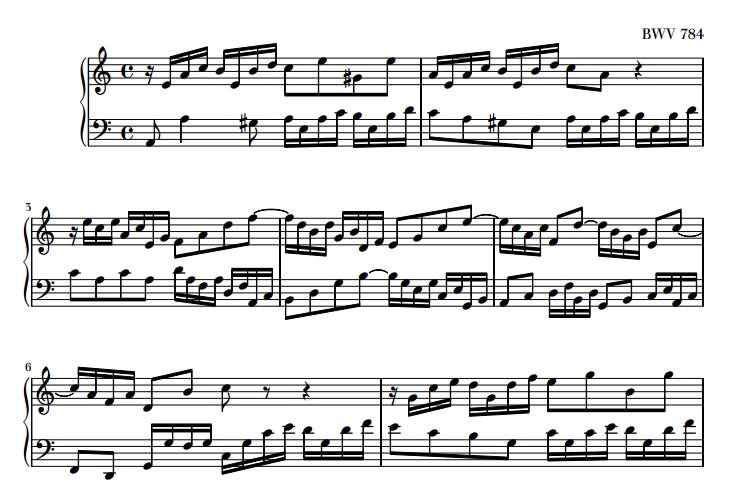
Earlier this term I began teaching Bach’s Invention in a minor, BWV 784 to one of my piano pupils. This is the beginning of her second term of lessons with me, and although she is a bright and diligent pupil, her tendency when learning a new piece is still simply to begin at the beginning and do her best to play the notes. The analogy which I often use is that of an intrepid explorer hacking her way through the dense jungle armed only with a machete – she’ll get there in the end – wherever there is – but it’s not going to be pretty! And when she does arrive at her destination, she’ll probably have little or no recollection of any detail of the journey along the way.

We can do better than that. Bach wrote these pieces to teach his pupils not only how to play, but also how music is put together. Why should we not do the same?

First of all, what key is it in? Pupil, being on the ball, answers A minor.
How does she know? There is no key signature, and there are G#s – which are the raised 7th. Good knowledge. [And how do I know it’s in A minor? From the title at the top of the page – “Invention in A minor”!]
And what is the other chord which Bach is most likely going to use? The dominant.
Excellent answer, and what is the dominant in this key? E. Finish your sentence….  E major. Good, the dominant in a minor key is major, because of the raised 7th.

Now, can you play me an arpeggio of A minor, just an octave up and down? Here’s the pulse. Of course she can. And now four whole beats worth, in quavers, but now you can change direction whenever you like. [Quick demonstration, with the pulse still going]. Again, it’s a straightforward task for her. And now the same, but this time let’s include some passing notes so that we have a mix of steps and thirds. No problem.

We quickly do the same in the dominant, and before long we are changing fluently between tonic and dominant every four beats, complete with a single bass note per bar in the left hand.

784

Now, and only now, do we look at the music in detail for the first time. Machete-style, she would have hacked away, one unrelated note at a time – such an unrewarding and largely meaningless task. But now she can see the arpeggio shapes instantly, and realises that the notes which aren’t in the arpeggio must be passing notes. So they make sense too. We notice that the E major arpeggios are actually dominant sevenths.

Going onto the second line (still playing RH only) she is quick to notice that everything is made of arpeggio shapes. How often does the chord change? Twice every bar. And then she notices that there is a sequence; her ears are also helping to guide her along what is looking more and more like a clear path, even though she has never been down it before. Observe, the circle of fifths in action rather than just presented as cold, dry theory – at last, we have found a use for it!

Now she plays through the left hand, and quickly notices that it is copying the right hand – imitation. And half way through bar 6, having noticed the same melodic shape but now starting on a different note, she observes that we have modulated – to C major. How’s that related? It’s the relative major.

This has probably taken about 10 to 15 minutes, but she now has a really good idea of the lie of the land of the whole piece. Initially it looked like a jungle, with huge areas of impenetrable semiquavers, but now that she can see the harmonic outline (and knows what to listen for) the way forward is just so much clearer. It is so much easier to learn when we understand how the music is put together.

What does the word ‘dynamics’ mean?

It’s a pretty common experience for me to hear concerts or competitions in schools where a large number of young soloists play one after another, and at one such event recently I was struck by the simple fact that some perform and others play; some are instantly compelling and just ‘have it’, whilst for others the whole experience can be pretty soulless.

Some find the whole ‘playing an instrument thing’ easier, undoubtedly, but I think what really sets them apart is that they have already made a connection that music is about being expressive. These are the ones that we might call talented. The others are not untalented – they just haven’t made that connection yet. I believe that they can, and of course their teacher has a big part to play in this. I have a piano pupil who, on paper, has it all – perfect pitch, brilliant sight-reader, secure technique and great work ethic. What more could you want? Well, as yet, she still plays rather than performs. If I ask her to play piano she’ll do that, but it can sound … well, dull, if I’m honest. Quiet, but no expression. She has talent, but some of it still needs unlocking. We’ll find it in due course, but in order to get there we need to make lots of connections with music being expressive.

Wikipedia tells us that “dynamics means how loud or quiet the music is.” Please no! Actually the word piano (p) translates as soft, which is so much more expressive. But still not specific enough in my book….

What would we normally understand by the word dynamics, in a different context? Wikipedia again:

dynamics: the forces or properties which stimulate growth, development, or change within a system or process.

Well done Wikipedia, that’s much more like it! Dynamics is a much bigger word than ‘how loud or soft?’ If we walked into a room and encountered a red-faced person shouting at someone else cowering in the corner, would we describe the dynamics in the room as loud? Angry, uncomfortable, tense, volatile maybe, but to describe the dynamics as loud would make for a pretty lame description, and even strong wouldn’t really do the job in this context.

mfSo, back to my piano pupil. I could instruct her, in great detail, to play each bar in a particular way – begin quietly, crescendo here etc – but who am I kidding? I know that this isn’t the way to draw out her musicianship. Worse, sadly, she might not know that; she could end up giving a very ‘musical’ performance and not have the first idea why – she’s just following my instructions. That would not be empowering teaching.
So I’m going to try an experiment this term: I’m going to ban the use of the following words in my lessons and rehearsals –  soft, piano, loud, forte – and instead use words like vibrant, energetic, punchy, reverent. In doing so, I hope that my students will be clear that music is always about being expressive in some way, and that dynamics is not just another element of the performance to be remembered along with the correct notes and fingerings.

Paul Harris’ new series of flashcards, Practice Starters (published by Faber) include this wonderful little exercise –

Play the last note or chord of a piece you’re learning. Now play it:

Abruptly       Calmly      Dying away-ly      Magnificently      Triumphantly

Nonchalantly       Happily       Unhappily      Surprisingly      Finally

These are dynamic words, and they will encourage your pupils to think expressively and creatively.

By way of a foot note, yesterday I had a rehearsal with a sixth form student ahead of her forthcoming Advanced Certificate diploma. She is an excellent singer, although in her own words, she over-thinks things, and I suggested that perhaps some of this might be getting in the way of giving a real performance. We talked briefly about the dynamics of the song. Not the volume – the real dynamics in the room which the character in the song is trying to convey, which is this case was joy. “Don’t think about support, intonation, vowels, just focus on the joy part.” The difference was dramatic, quite literally, and she knew it – a thrilling experience for both of us.

Top trumps

Every child has played top trumps at some point: let’s face it, so have most adults too. Whatever your favourite theme – cars, superheroes, dangerous animals – they all work in the same way. Each card has a score for certain characteristics, and the highest score wins.

top trump

Here’s how a game might sound –
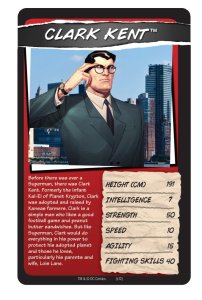
Player 1: Height, 182cm
Player 2: Height, 191cm. I win!
Player 1: Oh no, you’ve got Clark Kent haven’t you?!
[Player 1 is a real geek, and has memorised all of the data on all of the cards!!]

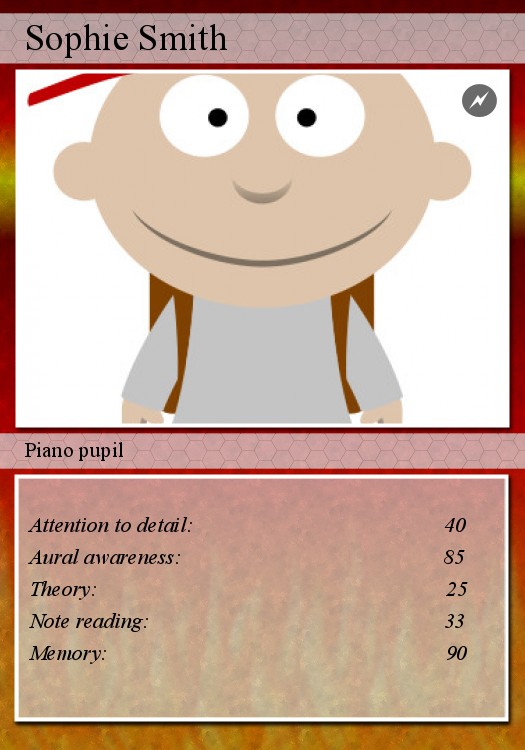
I’ve been thinking lately about devising top trump cards for my piano pupils. None of them are superheroes, or even dangerous animals (!) but they do have a variety of rateable skills. Self-assessed (that’s important and I’ll come back to that), a pupil card might look like this:


sophie smithMy point is this – why is the pupil calling note reading when that’s the weakest number on their card? Surely they’d have a better chance calling on the memory category.

Player 1: Note reading, 33
Player 2: Note reading, 98, I win!
Player 1 (geek): Oh that’s not fair, you must have Mr Bevan!
Player 2: I am Mr Bevan!!

Let’s take an example. A pupil is reading through a piece of music, perhaps for the second or third time, and is still struggling to read the notes. Some are on leger lines, it’s in A major and she keeps forgetting that there are G#s in the key signature. In short, her note reading is pretty weak (33 in fact). Time to draw on a different skill instead. How about memory (90)? After all, having played it through a couple of times now, she ought to have some recollection or either how it felt to play, physically, or maybe visually.

I’m not for a moment suggesting that we ignore reading skills altogether; we should be trying to develop all of these skills all of the time. [In this respect, my analogy to top trumps breaks down, as (hopefully) all of these numbers gradually increase as our pupils progress.] What I am suggesting is that we should be encouraging our pupils to draw on a variety of skills rather than just one. When it comes to learning new notes, I find that it can be a huge encouragement when our pupils realise that they don’t have to rely entirely on their reading skills. Discovering that memory, aural or even guess work can give an additional boost to their reading skills, which in turn may well boost their self-esteem.

For me this has also been a really helpful tool for encouraging pupils to make an honest (if approximate) assessment of their general musicianship skills. There is no harm in getting it out in the open that Susie’s note reading leaves a little to be desired – we both know that anyway don’t we? But it’s also a lovely opportunity to let her know that you agree that her memory is terrific, and that we should be looking for more ways to use that, since it’s clearly one of her real strengths.

Permission to sing badly

Instrumentalists have a lot to deal with when learning a new piece of music. Not only do they have to read the notes – both pitch and rhythm – but they also need to deal with the technical demands of playing them, which amongst other things may include fingers, arm movement and breath control. If they are finding the rhythm difficult, I’d like to suggest that we can make it a lot easier by removing the technical aspect, at least temporarily.

Can you juggle whilst riding a *unicycle? If you can’t do either, what are the chances of you learning, simultaneously, to do both? One of these alone would be quite enough to be dealing with, and you’d really need to be a master of each skill before you contemplated putting them together.

So if it’s understanding the rhythm of a piece of music which is causing the difficulty, put the instrument down! It seems so obvious, if you consider the unicycle scenario, and yet how many of us fail to do this? Perhaps it depends on whether we see ourselves principally as an instrumental teacher or a music teacher…. Fixing the rhythm is a musical problem.

The trouble, though, is this –  we do have a significant problem if we put down the instrument, because now we’re going to have to ….. SING! Most teenagers would naturally run away at this point, but I have a solution which seems to work really well; permission to sing badly!

In order for rhythm to be secure what we really need to do is internalise it – and singing is just an outward demonstration of what is going on inside our head. For this purpose the singing doesn’t need to be perfect, but the important thing is to learn the rhythm without having to focus on something else at the same time.

Earlier this week I was working on Ian Clarke’s Sunstreams with a flautist:

sunstreams

In this passage, there are a lot of notes to concentrate on playing. Up until this point her pulse had been rock solid, but all of a sudden in bar 24 it just disappeared and everything went very vague; it’s as if the volume had been turned right down on her internal metronome so that she was no longer aware of it.

First step: put down the flute. We then re-established the pulse, and made sure that she knew where each of the crotchet beats fell – she’s a quick student, so no problems here. And then we sang it – badly, but in time. Without inserting a sound file it’s difficult to describe bad singing, but basically you need to put enough inflection in the voice to show the rise and fall of the pitches, but with none of the precision need to sing it properly in tune. In effect it’s like an aural sketch – near enough to be recognisable, but without the need for all the detail.

With just a couple of repetitions she had built for herself an aural sketch of what this passage should sound like, in time. So when she picked her flute up again and played, it was, unsurprisingly, in time, because she now knew what she was aiming at.

This technique works so well, and I put it down to pupils enjoying having permission to do something badly! We so often feel judged on the quality of our singing, and indeed it’s a very personal thing. But to ask a student to singing badly, in this context at least, removes that pressure, because you’ve actually given them permission to get it sort of wrong, and where’s the stress in that? And they also see, almost instantly, how much easier it can sometimes be to learn without the complications of controlling the instrument as well.

*Funnily enough, not long after I’d written the first draft of this article, a pupil came to find me, with one arm in a sling, to say that he wouldn’t be able to go to his saxophone lesson – because he’d fallen backwards off his unicycle!!

Sight-reading hurdles

I have been working with a pupil recently on sight-reading, ahead of his forthcoming trumpet exam, and in particular I’ve been trying to encourage him to keep going at all costs. However, much as I have tried to persuade him to do this, I find that each time that he goes wrong, he stops to correct the mistakes. To his credit, his practice skills are pretty good; he is able to identify his own errors, and goes back to correct them. But try as I might to persuade him not to stop – to just keeping going – he can’t!

It has dawned on me that for much of the time we actually encourage our students to do the exact opposite, to stop in order to put things right; so is it any surprise that he does it in this context too?! After all, he’s just doing what I would usually ask the rest of the time – which is actually a good thing!

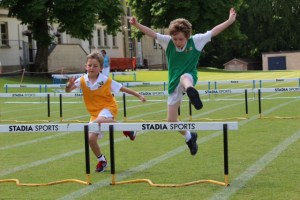
Charlie MaggsBut for a sight-reading test, we need a different approach. Don’t correct the mistakes! In fact, it’s not unlike running a hurdles race (although I need to stress that I speak with very little first hand experience!) In the hurdles the athletes quite often hit the barriers – sometimes they wobble, sometimes they fall over (the hurdles that is, hopefully not the athletes!) but what they never do is go back and have another go. They just keep going, sometimes leaving a trail of destruction behind them. It doesn’t matter – once the barrier has been hit, it’s too late to do anything about it, so they just keep running to the finish line. In some ways, it’s quite satisfying to make mistakes and then to almost literally run away from them!

And it’s the last bit – the idea that for once it’s actually correct to ignore the mistakes – which has made the difference with this pupil, and I think he has actually found it surprisingly liberating to be allowed to plough on without fear of recrimination! The ideal, of course, is that there are no mistakes, but failing that being allowed (or even encouraged) to ignore any mistakes has been quite …. fun!! Sssshh, don’t tell anyone!! 😉