Category Archives: teaching

Reading notation: If you can’t say it, you can’t play it

When learning a piece of music – and when teaching a new piece of music – I always consider how I can make things as easy as possible, and this invariably means breaking the music down into tiny pieces so that every element is as simple as possible. For a pianist, that might well mean separate hands, but even beyond that it might be to break down each bar so that we can identify different hand shapes, finger patterns, harmonic outlines, interval relationships and so on. Paul Harris would call this making connections. This turns reading into learning.

When it comes to rhythm, this might also mean putting down the instrument and just dealing with the rhythm bit. After all, if you can’t even clap or sing the rhythm, or even just say it, then what are the chances of being able to play it on your instrument? Zero, I’d say.

Some of my pupils are quite surprised when I first ask them to take their hands off the keys and work at the rhythm by itself – after all, this is a piano lesson, and singing or clapping can be a little embarrassing! But they soon realise that actually it’s really helpful to know how the rhythm goes by itself, and that it’s a lot easier because they have less to think about.

Last week I found myself helping a pupil with a difficult rhythm in a Field Nocturne – 4 against 3. Having practised hands separately – the right thing to do – she had been trying her best to put the two together, but was frustrated that it wasn’t working. The reality was that she just didn’t know how the two parts fitted together.

IMSLP272546-PMLP24011-field_8_nocturnes_349854157

First things first; dealing with a complex rhythm and that mobile left hand accompaniment is just too much to cope with, so let’s remove the pitch element. In fact, let’s just take the piano out of the equation altogether and just deal with the rhythm by itself. I suspect that this idea doesn’t always occur to the instrumentalist, but it should.

Stage one is to work out how they fit together. They say that maths and music go together, and I guess this is what they mean! 4 against 3 looks like this:

4 against 3

Practise tapping left and right hands on knees until fluent.

Stage two, let’s sing the melody line so that we actually know how it goes, rather than just being able to play it – two very different things.

Stage three. A fusion of the rhythm and melody – but still no piano. We sing the right hand melody, and either tap the left hand rhythm, or better still, sing that too! So we end up singing the top line (down an octave, obviously) and doing our best to sing it in tune, and also saying/singing badly the left hand in the correct rhythm. Clearly it’s impossible to sing a two part piano piece, but in essence we’ll do our best. The most important thing is this: although the singing itself might not be brilliant, it represents what is going on in our inner hearing, and if it works in there, it will work on the outside too.

Stage four. If you can say it, you can play it! Now that the whole thing is mastered, we simply add the element of playing the notes.

In real time, this took about 10 minutes of the lesson, maybe 15. And in this time, we didn’t touch the piano. Does that matter? Not in the slightest, this is a music lesson. The best bit is that, having done the hands separately work already, it went together instantly, and I do mean instantly. With a huge smile!

Count me in!

This morning I gave a student a short canon to learn, and began by suggesting that he clapped the rhythm first, before trying to sing it. His attempt was pretty unsuccessful, and so I set about trying to work out what was going wrong. He could cope with crotchets and minims, but as soon as things moved to dotted notes and quavers it quickly fell apart – he appeared to be considering each note as an individual unit, rather than looking at the whole bar in the context of the pulse. In other words, counting 2 for a minim and 1 for a crotchet is fine, but how do you count 1 and a half for a dotted crotchet, or half for a quaver? I think the simple answer here was with difficulty, evidently!

canon

However, once I suggested that he tried counting the pulse aloud – 1, 2, 3, 4 – and then clapping the rhythm within the context of that pulse, his attempts were significantly better, and he went on to sight-clap (is that a term?) several other rhythms almost perfectly. Instant results! It seems that he has just been missing a tiny but vital hint which has now put all of his knowledge into a much more workable method.

Intrigued, I ran the same test on another pupil later on the same day, and with exactly the same results; she too counted the length of each note in turn rather than in the context of the pulse, and as soon as dotted crotchets and quavers appeared she went to pieces. I asked her how the counting went in her head:
“1-2, 1-2, 1, 1-2, 1, 1 er ….?”

As ever, the same question looms in my mind when I discover pupils with such glaring holes in their skill set – alarmingly both of these pupils are beyond Grade 5. How have they got this far without someone having fixed such an elementary issue?

I’d like to offer two answers to this question. The first might be this: because they disguise their weaknesses, either knowingly or otherwise, learning to navigate their way around difficulties by other means. In my experience, children can show all the outward signs of understanding something when in reality their understanding is far from secure! For instance, if the pupil has a quick ear, and the teacher is kind enough to play the piece first, the rhythm might not be read at all, just remembered. Handy for the student, but unwittingly we might actually not have helped them very much with that initial play through. To learn that piece maybe, but not to develop the skills to learn any piece.

The second answer might be that nobody has taken the trouble to fix it. How often do we ask our pupils to clap the rhythm of a piece before playing it? And much more importantly, if it’s not spot on, do we just ‘put it right’ – “it goes like this, now you try” – or do we actually dig a little deeper and work out how to help them to put it right for themselves. Telling is not teaching, but so often it’s a quick and easy way to get results.

Once again I find that Two-part hearing development, a collection of two-part canons selected by David Vinden, is a truly wonderful teaching resource. If a pupil can clap their way through this volume then I can be sure that I can count on their rhythmic security.

“Fun is a momentary thing” – Nicola Benedetti

I was very impressed by a recent article in The Daily Telegraph – No one is pulling Nicola Benedetti’s strings. Benedetti is a wonderful ambassador for music education, and the phrase that particularly struck me in this piece was this:

“The benefits of persevering are so much more than what everyone usually obsesses over, which is having fun. Fun is great, but fun is a momentary thing – it’s not something you can fill your life with, or that will sustain you through hardships. I wish this was vocalised in education.”

Well, I heartily agree! This is something which I believe to be a genuine problem in teaching our young musicians; not of Benedetti’s calibre of course, because although she cites her parents as insisting that she practised hard, I suspect that the driving force has always been Nicola herself. But with young people who are learning to play an instrument, but possibly don’t have aspirations to become a world class soloist, setting the sights appropriately is not always easy.

Who is responsible for setting those sights? Teacher, parent and pupil?

“We want his lessons to be fun” is perhaps a line which I hear all too often when parents request music lessons for their child. I like to think that they have just made a poor choice of word, and that “fulfilling” or “engaging” or “challenging” might be closer to what they actually mean. But reading Benedetti’s quote above, maybe they don’t! It worries me that they might actually mean “fun”, that momentary thing which although ….. well, fun ….. doesn’t really change much. It seems to me to be a strange factor to have at the top of the list of desired outcomes, especially when one considers the very real expense of individual music lessons.

Whilst I would hope that every teacher is consistently striving to raise their game, to engage and inspire their pupils at whatever level they are at, there is no question that without hard work and perseverance on the student’s part they are unlikely to make good progress. Students should not be going along to lessons each week expecting the teacher to do all the work, all the inspiring – that’s a pretty passive learning environment, if indeed it is a learning environment at all. I find that the most successful pupils are the ones who take responsibility for their own learning and who bring ideas to their lessons as well as leaving with some. Regular practice and perseverance also play a key part in the process, and these can bring a deep and lasting satisfaction. In short, hard work is where the riches lie!

Diploma – so what have I learned?

Several weeks have now passed since I took the dipABRSM diploma in Piano Performance. Results are not published until early in September*, and although I am of course eager to know how I fared, there is no doubt that I have learned a huge amount from this enterprise regardless of what the examiners say! Since it was undertaken largely as a professional development exercise, herewith some thoughts on what I have gained from the experience.

Before that, a little professional context lest I do myself some injustice. As an organist I won a scholarship to the Royal College of Music in London, and whilst there I won all the major prizes for organ playing, as well as obtaining an MMus in Performance Studies and the ARCM and ARCO diplomas. I am highly trained, and know how to give a first class performance. So my objective here was not to see whether I can pass a piano playing diploma, but rather to see whether I can give a 35 minute piano recital, under pressure, from memory.

I can. The principle thing which I have learned is that, given the right mind set, it is possible to achieve things which might otherwise seem well out of reach. If I’m honest I knew this already – but what I have realised is that this is a fundamental problem for some learners, and that many simply can’t get past I can’t. This is something which I hear all the time in the course of my teaching, and although I do my best to be sympathetic I’m afraid I don’t have much time for it! Arguably that’s what teaching is about – turning I can’t into I can – but the student also has to have the courage to set a new course. And it does take courage. And it can take time, and will often require a great deal of hard work and effort, and I mean a great deal.

I have lost count of the number of times that a pupil has told me, for instance, that they can’t sing the melody of their piano piece, but on realising that I am not going to give up asking they have eventually taken courage and gone on to sing it back perfectly! The I can’t here is just an excuse and not to be taken seriously – more like I won’t or I’m worried I’m going to fail so I’m not going to try. More often than not, from my perspective, the hard facts say that there is no reason at all why it shouldn’t be possible, which is why I tend to take on the dreaded I can’t rather than allowing my pupils to succumb to it. The best learners are those who take on their I can’ts and work out how to overcome them.

I’m not going to pretend that this diploma has not been a big deal for me, and the target which I set myself has not been an easy one to meet. With the music, the diploma exam would have been extremely straightforward, and for me, pretty pointless actually. Without the music, a new set of skills required and a great deal of work has gone into turning a dream into a reality; and having come through the other side I can now enjoy all sorts of new opportunities which were closed to me before. In fact, I don’t think it is an overstatement to say that this experience has transformed me as a musician.

But if there is just one thing which I will take away from this venture – apart from the extraordinary change in my own playing as a result of the freedom which memory allows – it is a renewed desire to ensure that my teaching is challenging. Not to be unreasonably demanding, but to ensure that our musicians are encouraged and taught how to make demands of themselves, to fight through a few I can’ts and realise that they can achieve amazing things if they have the right mind set.

[*Passed with distinction!]

Aural tests – just sing!

I have discovered the most wonderful resource for musicianship training – canonsSo much can be covered with the simplest of four bar canons, and perhaps the greatest beauty of all is that you need nothing more than two voices.

Take the following example:

canon3


The first objective should be to sight-sing the melody using solfa. I insist that my pupils do this, for two reasons. Firstly, it gives each note its place value in the key. And secondly, it is extremely focusing to be thinking about both pitch and syllable  – there is no room for passive participation here! Initially even a simple melody may prove quite testing, but this active engagement of the brain, this constant thinking ahead, is an excellent skill to be developing right alongside the aural skills.

Alternatively, or perhaps after an initial attempt at sight-singing, you can learn to sing it from memory, perhaps in two halves at first, but still using solfa.

With a more able pupil, you might dive in straight away and ask them to sing after you, in canon. This allows them either to read the notes as they sing, or else to memorize what you sung and follow that way – or ideally a combination of both. Still in solfa. They might get the notes right but a few syllables wrong – don’t allow them to get off lightly! Even if they get the melody perfectly correct, insist that the solfa is correct too, even if it takes a few more attempts.

And then there are the hand signs! These can be introduced whilst you are just singing in unison, and your pupil should sign too. The ultimate test, of course, is to sing the canon whilst signing the second part a bar later. But be warned, make sure you have practised this before you demonstrate in front of your pupil – it’s not easy!

A quick glance down the aural test requirements for the early ABRSM grades will show you just how much a little of the above covers:

  • Pulse. Singing together and in canon enhances an awareness of both rhythm and pulse.
  • Echo responses. Memorizing short phrases.
  • Recognising changes. Singing in canon requires careful listening to both rhythm and pitch, and students will soon be identifing their own errors.
  • Sight-singing notes in free time (Grades 4 & 5). The key here is solfa, and learning a few tuneful canons in this way will soon make the ABRSM tests seem insultingly easy.
  • Sing back a phrase. No problem – your student can now sing back a phrase at the same time as listening to how it continues!
  • Tonality. The place value which solfa brings (you just can’t sing mi without having worked out that it is the 3rd of the chord) is excellent for developing a sense of key, and singing in canon also encourages the student to listen carefully to the harmonies produced between the voices.
  • Singing back the lower/upper part. Once you have practised a few example, see whether your pupil can sing in canon without sight of the music; this really does develop their ability to hear one part and sing another.

I find teaching the ABRSM tests in order to pass the exam to be a pretty painful experience – but just learning and singing together a simple canon, even for a few minutes each lesson, is quite the opposite. Delightfully pure and simple, but incredibly focusing for both pupil and teacher alike. Let’s put the instrument down, or step away from the piano for a few moments, and sing!

This canon is the very first in a book of 109 canons selected by David Vinden in ‘Two-part hearing development” which is available here.

Plus …. a fab solfa video here!

As easy as do re mi? A “beginner’s” guide to solfa

For as long as I can remember I have been able to sight-sing with confidence, doubtless due to my early training as a chorister and subsequent involvement with choirs for many years since. It still remains, for me, the most important thing for any musician – to be able to sing.

Three years ago I signed up for a British Kodàly Academy Spring Course. I can’t quite remember why, but one of the things which did interest me was the knowledge that the Kodàly approach uses solfège, the naming of each note of the scale as do, re, mi, fa, so, la, ti, do. I was interested to see whether there was anything in it, since I had my doubts – after all, I could sight-sing perfectly adequately without, so what possible use could giving all the notes funny names be to me? As I soon discovered, I was missing the point.

The first event of Day One was choir. We learned a song from memory by repeating back phrases sung by our director, which was challenging for one reason only – we were expected to sing in solfa! For me pitching the notes was easy, but remembering which solfa name to sing them to was not, and immediately I found my brain racing to keep up. And it was relentless! Just as I thought I had the hang of it, we cut to something different – learning another melody, or clapping and/or stamping a complex syncopated rhythm. And then (I should have seen it coming!) we put all of them together; melody, rhythm, others singing the countermelody, and the solfa! By the time the hour was up I felt like I’d done a day’s mental workout. They say that music uses both sides of the brain – definitely!

HandSigns

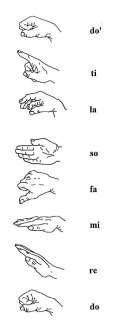
And then on to musicianship training. I was aware that there are different hand signs for each of the solfa syllables, but was not yet aware of their full potential. We learned some relatively simple pentatonic melodies from memory, and again the most difficult element was singing the solfa names. By now I realised that I was becoming much more actively aware of the relative position of each note in the scale, rather than just pitching each note from the previous one. The latter system still worked for the pitch, of course, just not for the name. Interesting. And then we were asked to perform a melody in canon. First at the piano; play first, and start singing a bar later (in solfa). Challenging, but manageable, and I have to say I felt very proud of myself for negotiating the task successfully, albeit with my brain running at full tilt. And then with hand signs. That’s right, sing first (in solfa) and then sign the canon a bar later with the solfa hand signs. “You’ve got to be joking” I said to Klara, the delightful Hungarian lady who was taking our class. Evidently she wasn’t. As encouragement, she performed the canon in three parts, using both hands, without even breaking a sweat! Respect.

Back in choir, I soon discovered that when the music changes key, do moves too – and so of course does everything else! Never before have I been so intensely aware of the place value of each note in a melody, and in observing every modulation as it occurs. I realised that much of the time I sight-sing on autopilot; yes, I am constantly listening, but perhaps not always thinking so hard. On the other hand, solfa actively forces you to listen and to analyse, and the intensity of this experience is actually very surprising. It is an amazingly powerful tool for teaching complete novices (as my Choir who can’t sing will testify) right through to analysing Schubert symphonies in detail, which I did on this year’s Spring Course.

This approach to musicianship is so refreshingly rigorous, and I love it!

Singing for pianists

The third of my five ‘E’s for outstanding instrumental teaching is developing an Enquiring mind. I think that it is vital that the teacher gets into the habit of asking questions rather than answering them, so that the student quickly learns that he is expected to work things out for himself. A simple example: “don’t forget the E flat in bar 5” becomes “which note did you play wrong in bar 5?” It is so easy to fall into the trap of giving the answers, but telling is not teaching and we should not be in so much of a hurry to teach a piece of music that we forget to teach the student.

Assuming the student answered the question correctly, let’s make the next question a little more difficult: “Can you sing me the E flat please?” At this point, in 9 out of 10 cases, the student will reach for an E flat on the piano – if they get the chance that is, because I’m ready for them! “No, don’t play it, sing it.” For me, this really gets to the crux of the problem. Sitting at a piano is like having a calculator in an arithmetic exam, but easier; if you want to know an answer, just press the relevant key and the answer is immediate.

At the simplest level, this is going to test the student’s aural memory. Can they remember, in their inner ear, any of the notes which they have been playing in the last few moments? The questions which they need to ask themselves are going to be the equivalent of a mathematician showing how they reached the answer – if they think that you are just expecting them to pull an E flat out of the air then of course they have every reason to panic!

A few more leading questions might help; “The phrase started on a B flat, can you remember what that sounded like? Yes? Well, can you sing me a B flat then?” Once they have sung the B flat, a little theory might be required: “How far away is E flat from B flat? Ok, sing up a four note scale from the B flat and we should get there!”

My piano pupils are used to this type of questioning, resigned to it perhaps! They realise that I am serious, however, and although in the early days some will just dig their heels in and refuse to sing – I had a pupil once who took weeks and weeks even to pluck up the courage to proffer a single squeak – they all know that it is an expectation. The benefit, of course, is that they are using their ears, and they soon realise that it can be quite helpful to have their ears connected up with what their fingers are doing.

This style of teaching encourages the student to use their brain, their memory, their ears, their knowledge of theory, their voice …. and sometimes diversionary tactics! The alternative “don’t forget the E flat in bar 5” seems unhelpful in comparison.

Musicianship

I think of myself more as a musician who plays the piano, rather than a pianist. I’m more interested in the music itself than the mechanics of it.   Martin Roscoe                                                            

I was delighted to hear Martin Roscoe say this in a recent interview, since it mirrors almost exactly my own sentiments when it comes to teaching. A quote from a blog post of mine from just a few months ago:

I find it very helpful to think of myself first and foremost as a music teacher, but one who just happens to teach that musicianship through the piano.

Sadly, unlike Martin I don’t think that I will ever reach the point where I will be able to let the ‘mechanics’ of playing the piano take care of themselves! But let’s get back down to earth and summarise:

It’s about the music.

A good proportion of my piano teaching is concerned with forming a solid technique. The purpose of the technique is to serve the music effectively, so that the pianist is able to express their intentions at whatever level they happen to be performing. I am also passionate about the mechanics of learning, and in particular in how to transfer the skills necessary for a pupil to become self-sufficient.

But what happens if the student just isn’t very musical? The answer is stunningly obvious  – we need to draw out their musicianship. I really can’t see the point of teaching the mechanics if the musicianship is neglected, since the student will have nothing to communicate if they have no musical understanding. And yet I find myself, on a daily basis, encountering young musicians who are ploughing through the ABRSM/Trinity grades with little understanding of the music which they are playing because the focus is too much on the mechanics, and not enough on the music itself. I am not talking about instructing pupils how to play musically. No, it is about drawing out an understanding so that they know for themselves how to play musically. The difference is vast.

Since coming to Monkton some three and a half years ago I have done a lot of work with ‘non-musicians’. The tone deaf project and The Choir who can’t sing are clear indications to me that to write off the ‘non-musician’ is a serious mistake. I am also convinced that the way forward is to train the musician first, because this the the bit which lasts. In order to do this, the focus needs to be on musical things – aural skills and inner hearing, understanding the implications of harmonic progressions etc. If that means going a little slower with repertoire in order to further the musicianship of the pupil, that shouldn’t be a problem!

How much can you achieve in half an hour?

My first piano teacher, Ethel May, was a little old lady who lived on the other side of town. She had a fine reputation as a teacher, and I suspect that a large part of the success of her pupils was due quite simply to her expectations when it came to practising; when she took me on, aged six, it was on the clear understanding that she would only teach me if I practised for half an hour every day.

I am reliably informed (by my former practice coach – thanks Mum!) that I used to do my practice in two 15 minute sessions every day. Thinking back to my first piano book, and those first few simple pieces (with thumbs always over middle C) I am struck by how much I must have been able to achieve on 3 hours a week! With that amount of time, I must have arrived at each lesson having played those little pieces hundreds of times, with time to spare to lovingly choreograph each finger movement, and doubtless to memorise the notes too. I really don’t remember, but I suspect that by mid-week I must have been ready to turn a few more pages and forge ahead by myself, having had more than enough time to master the work set.

Many years on, I have never found it too difficult to guess how much practice my pupils have (or haven’t) done each week. There are lots of clues, ranging from seeing the music falling open to the right page – in contrast to the pupil not even knowing which page their piece is on – to noting whether they can start playing straight away or whether they have to work out what the notes in the first chord are before they can even start!

What I am completely confident about, however, is that half an hour a week is not enough. For anyone learning any instrument at any level. After the lesson which I taught this morning, I am confident that my pupil (working towards Grade 7) has all that she needs in the understanding and technique departments to completely master the passage which we were working on; the only other component which now needs to be thrown into the mix is Time. If she spends half an hour every day on it, she will know every little moment – the note which she always forgets (D flat!), the differing chord weighting required in the right hand accompaniment, the left hand chord sequence and associated finger patterns – she can’t fail to. But on half an hour a week (that’s just five minutes a day) she might have had a chance to play through the passage a few times, but the familiarity will simply not come in that time. Time and practice is what is needed.

In a busy boarding school environment, I think it’s probably quite easy to slip into the “she’s got so much else on, so I ought to be pleased if she can manage to practice for an hour a week” mentality. On reflection, I just can’t see how this works, and we are deceiving our pupils if we fall into the trap of allowing them to believe that ‘not much practice’ is okay. On the other hand, half an hour a day + good teaching will ensure excellent progress; personally, I’d read that as a bare minimum.

[As an after-thought, I did some sums. We currently teach 208 music lessons each week. If each pupil practised for half an hour a day, that would generate 104 hours of practice every day; with 12 practice rooms available in our wonderful new music department, that would guarantee full use of each one from 8.45 until 5.30 every day. That would be amazing!]

Sight read no jumps

I was fortunate enough to gain a place as a chorister in a parish church at the age of eight, and received five years of the most wonderful musical training. In fact, there was a series of very specific tests which we were expected to work through, and success was rewarded with a coloured drawing pin on a chart. Wow! (Actually, I was hooked from day one!)

stMary's1980

More specifically, there were 7 blue, 15 red, 5 green and 5 purple tests. The blue ones were along the lines of ‘read a hymn’ (Immortal, invisible, God only wise,
In light inaccessible hid from our eyes!), sing a scale G to G etc – all things which a seven/eight year old needed to get to grips with if he was going to progress to becoming a ‘full chorister.’ It was a very simple system, but the tests became increasingly demanding – I can’t remember what any of the purple ones were, but they were probably along the lines of ‘process down the nave of the church with a candle in one hand, whilst sight-reading the alto line of Stanford in G with the music upside down!’

However, I do remember several red ones, including ‘sight-read no jumps’. Our assistant choirmaster, Mr Baker, would draw a stave, a treble clef, and a major scale from middle C to top G, on the back of a scrap of paper. All that was required was to be able to sing up and down the scale, by step, as he pointed to each note, but changing direction occasionally. The aural equivalent of going up or down a ladder, one rung at a time. Looking back, we must have learned

  • the ‘sound world’ of the major scale
  • where the tones and semitones were
  • that next door notes move either from line to space, or from space to line

Not too tricky once you got the hang of it, but nevertheless something which needed practise and familiarity. Sight-read jumps, on the other hand, was fiendish, and the test board, all neatly organised in rows and columns, had a notably empty column under this heading – the few boys with a red drawing pin at this point were held in great esteem, and quite rightly! In short, if you can do this, you can do anything, and I do mean that quite sincerely.

Sight read no jumps is not difficult, but I believe that it is necessary for all musicians to practise it and master it. I regularly encounter young musicians (and also older ones) who quite simply can’t sing from one note to the next. I find it difficult to allow them to justify why not – scales are the alphabet which we work with, and we must have a basic working knowledge of the scale. They might not like it, but when I ask my piano pupils to sing a musical line in lessons, they know that I’m serious and they just get on with it. After all, the ears need just as much training as the fingers.