Category Archives: the choir who can’t sing

Can you sing? Apparently, 34% of people can’t!*

This October I sent a short questionnaire, Can you sing? to the whole school. More specifically, to all pupils at our senior school, and staff of both senior and prep schools.

singing survey

*Sorry about the sensational title! This figure comes from a sample of 359 replies [69% of the pupil body returned the questionnaire] but nonetheless it is a significant number of people, and the data makes for fascinating reading.

My initial intention was to discover how many might call themselves tone deaf, and I’ll come to that in a moment; but what has shocked me is this: 44% have been told by someone that they can’t sing. And in response to the question ‘Can you sing?’ (answer either yes or no), 34% said no, they can’t sing.

I wonder how many of those 122 people who say that they can’t sing have come to that conclusion because they’ve believed someone who has told them that, even if it might not actually be true. Of course teenagers can have a tendency to be down on themselves, and so that figure of 35% might be exaggerated: but then again, look at the numbers for our adult population – 31% of the school staff also say that they can’t sing. In a recent assembly the headmaster talked about the importance of developing into the person we want to be, not into the person which other people want us to be. Thought-provoking, as always, but not easy when those around us can have such a big influence on us, perhaps more often than not without us even realising it.

Arguably, ‘Can you sing?’ might be understood in a number of different ways. Maybe the implication here is ‘Are you allowed to sing?’ In other words, do those around you enable you to sing by allowing you to express yourself, or do they, either deliberately or otherwise, resign you to keeping quiet until singing becomes something you ‘can’t do.’

If it’s not bad enough being told that you can’t sing, 56 people (16%) in this sample described themselves as tone deaf. Of those, 10 have been ‘diagnosed’ by their parents, 25 by friends and 10 by …. their music teacher. How depressing. Sadly I know all too many people who have been silenced by those closest to them. Perhaps they think it’s funny, but I’ve seen reactions from boys in the ‘Choir who can’t sing’ which would suggest otherwise. Please don’t ever tell anyone they can’t sing – you might just be sentencing them to a life without all of the richness which singing brings.

Wikipedia will tell you that about 4% of the population suffer from tone deafness, aka Congenital amusia. Don’t believe it. I’d love to know where this statistic comes from – maybe it’s the proportion of people who think they are tone deaf. But I’m up for proving them wrong either way! Of the 56 in my survey, 19 say that they’d love to be able to sing, and 26 describe themselves as ‘hopeless’. From my experience with the Choir who can’t sing and others,  I’d be very surprised if most of these aren’t prepared to permit me to give them a slightly more professional opinion on their ‘diagnosis’.

Not sure when I’m going to find the time to do this, but the plan now is to see as many of these so-called tone deaf people as possible, and to see whether I can bring that supposed 16% down to a realistic much less than 4%. I’ll report back in due course….

SingTrue – a brilliant new app

As I’ve said before, I have come to the conclusion that there are three things which are vital in order to be able to sing well. These are:

critical listening [ears]

good breathing [voice]

confidence [mind]

Last term I took on the challenge of teaching a young member of our sports staff to sing. She revealed over lunch one day that not only could she not sing, but that she was terrified of singing. I found this hard to believe – she seemed like the confident type to me! So it was with great surprise, when she came for her first lesson, that I discovered that she really was completely traumatized even by the prospect of singing, to the point where she was reduced to a quivering wreck. Genuinely so. I won’t forget that lesson, ever.

singtrue2Over the coming weeks we coined the term ‘humming lessons’! It quickly became apparent that our main difficulty was simply going to be able to get her to make any sound at all, never mind dealing with any pitching issues. And when, eventually, she managed to hum a note, it became clear that her ability to pitch was as bad as I’ve ever encountered (that’s bad, by the way). Wow, what a project!
On the whole, without practice things don’t get better. Using a knife and fork is tricky at first. And if as a trumpet player your tone is a little rough, it doesn’t actually get any better unless you practise regularly. And if you haven’t sung for the best part of *15 years since being publically humilated in front of the rest of the class in Year Five, you won’t have had much practice at pitching notes accurately.

Several months ago I was contacted by Christopher Sutton from EasyEarTraining.com, who was planning on designing an app to help people to sing. He had encountered our Choir who can’t sing project on my blog, and wanted to tap into my experience. I had my doubts; after all, probably the biggest part of this whole initiative depends on me! The whole confidence thing is tackled by me getting alongside each individual and saying ‘Come on, I believe you can do this!
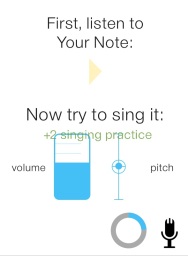
targetEnter SingTrue, launched next week for iPhone/iPad, and in a word, brilliant! No surprise that there are three modules – ears, voice, mind. I have been amazed (and flattered) to see so many of my little teaching tricks – and those of others too – incorporated into this clever piece of software. I’ve been been playing with the app for the last few days (official release date 21 October) but it has suddenly dawned on me that there is one potentially huge problem with my teaching; me! I’m there, in the room, with my pupil. And therefore the whole confidence element is a problem. In many instances it’s not insurmountable, and in fact most boys just get on with it. Girls generally find this more difficult though, and in the case of this pupil, I realise now that I was getting in the way! I think this is a great app. I wouldn’t want to be replaced by an app, but it does allow those who’ve had no practice to have a go, without fear of being heard by anyone – however encouraging their teacher might try to be.

*Insert your own number if this story sounds all too familiar. Sadly, I often encounter people, many in their forties or fifties, who have never sung because they were told as a child that they couldn’t. And so they haven’t 😦

[August 2017 – staggered to discover that apparently 450,000 people (!) have ‘found their note’ using Singtrue]

Learning to sing, one step at a time

One of the things which I have found time and time again with people who can’t sing is that you really can’t take for granted that they understand how up and down works! More specifically, getting them to sing the correct note back is one thing, but then we get to the really tricky bit – how far is down?!

I have a new ‘project’ this term, a sixth former who wants to learn to sing. I heard her early last term, and at that point she was having real difficulty in singing back a note even remotely close to what I had sung to her. However, in just ten minutes she made huge progress, taking on board the three things which appear to me to be so vital – critical listening, good breath support and confidence. So what impressed me immediately when I saw her this Friday was that she had clearly mulled these things over since the summer, to the extent that she was generally able to sing back a random selection of single notes pretty accurately. A bit out of tune perhaps, but close enough for the moment!

Having established F (above middle C) as her ‘go to’ note, I set out to extend this down the scale from soh to doh. So I asked her to sing down a ‘step’. [Remember, her pitching is still unreliable.] I sang her an E flat, and she sang me …. a middle C. A perfect fourth down – that’s miles out!

The trouble is, she doesn’t know how far a ‘step’ is. If the scale is seen as a ladder, she clearly has no idea how far apart the rungs are! It might appear extraordinary, but for those who struggle, we simply can’t assume that they know how the scale works. ‘Down a step’ is a vague concept, as vague as asking someone to move ‘one’ to their left. One what? One inch? One metre?

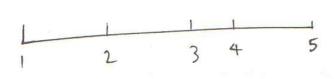
After a little more ‘calibration’ we eventually managed to start singing down five note scales – soh, fa, mi, re, doh. And here’s the interesting bit; although she now had a pretty good feel for how far a ‘step’ was, she still ended up too low by the time she reached the bottom of the scale. And the reason why? Because there is a semitone between fa and mi.

mifa21

What sensible scale, outside the realms of music, has a different distance between two points in an otherwise equal pattern?! Crazy! So actually, despite her lack of experience, I found myself admiring the combination of her logic and her new-found pitching skills. And once I’d pointed out that, for some strange reason, one of the ‘rungs’ in the major scale is smaller than the others, she quickly grasped the concept and her five note scales dropped rather beautifully into place.

How many young instrumentalists play scales and remain completely unaware of this strange phenomenon of tones and semitones? Quite a lot at a guess – they don’t need to know, because their instrument does the hard work for them. I think that’s a shame. And I also think it’s quite ironic that my new student, equipped with this little piece of knowledge, is beginning to make fantastic progress with her aural skills, and in some ways might already be seen as ahead of the game.

From Aaarrr to Aaahh – the pirate who learned to sing!

Back in September I posted a blog about one particular boy in ‘The Choir who can’t sing’ who had auditioned successfully for our production of The Pirates of Penzance. In fact, no fewer than five boys from the choir ended up as pirates in the show last weekend, which had a run of three nights and which was a fantastic success – and yes I’m biased, but I wasn’t the only one to think so – “we are blown away by the show!”

It has been a tough road. After casting, the producer and I wondered whether we had bitten off more than we could chew, since the combined musical talents of the boys in the chorus did not fill us with great hope. (Sorry we doubted you!) The initial sing through had some high points though, and I was delighted that the whole chorus, girls and boys, were so swiftly taken with the witty words and catchy tunes of this Gilbert and Sullivan classic. However, the reality soon hit home; for some – who could neither read the notes, pitch them reliably or remember them – it was looking like a mountain too high to climb. Some of the boys came to rehearsals looking resigned at best, and sometimes completely defeated.

One of the main problems was range – for boys used to ‘growling’ in the lower registers, they found it difficult to maintain the stamina required to sing at least an octave higher than usual. The other was that as soon as we were joined by the girls for tutti rehearsals, they almost invariably ended up singing the main melody rather than the bass line. Frustrating but understandable! And of course, even worse is that once you throw in the choreography, everyone stops singing anyway, at least initially!

Nothing beats practice, and especially when it is a little and often! With rehearsals set on Mondays, Tuesday, Wednesdays, Thursdays and some Sunday afternoons, the whole cast were sure of at least two chorus rehearsals every week, either sectional or together. For one particular pirate, I can’t imagine a better way of getting him singing – having never sung a decent note in his life – than doing a little every day for 10 weeks. His confidence has gone through the roof, and although he is still a little hit and miss, having been part of a show like this will have given him an immense sense of achievement which will remain with him for many years.

If I play you a note, can you sing it back?

When I see a pupil in order to practise aural tests, which I have done literally hundreds of times, the first thing I always do is ask them to sing a note. Surprisingly often it plays out something like this:

Me:  Sing this note to me please. [plays note on piano]
Pupil:  Can you play the note again please?
Me:  But I’ve only just played it!
Pupil:  Yes, but I’ve forgotten it!

The request to hear it again might even come whilst the note is still sounding! Of course it may well be that the pupil is using stalling tactics – any excuse not to have to sing. It can be scary, and I do mean that quite sincerely. Worse, however, is that I suspect that many genuinely believe that they can’t remember the pitch. At this point I have to insist, gently but firmly:

Me:  Just sing the note.
Pupil:  I can’t.
Me:  Sing it.
Pupil:  Lah! (correct note)
Me:  Well done!
Pupil:  Oh!

The thing is, unless they have genuine pitching problems they will almost invariably get it right; the only problem has been in believing that they can remember it.

Following my recent post 17 x 24? Fantastic thinking, I have been asking numerous colleagues and pupils to work out this sum for me, out loud. Quite a few, including several staff, have said that they couldn’t do that. At this point, I have had to insist, gently but firmly (!) and all have gone on to work it out correctly! This says a great deal to me about what we believe we can or can’t do, versus what we can actually do if we push ourselves a little more. In order to do this sum, we need to store a few numbers with a view to recalling them again; we might not think we can do this, but actually we can. And it is exactly the same with pitch; if we listen in the knowledge that we will be asked to recall that information, we can do it. We just need to ignore the ‘lazy’ voice in us which says we can’t!

I have been working this term with a boy who is in the Choir who can’t sing. He is preparing for a Grade 8 instrumental exam (ABRSM) in the summer, for which the aural tests are very demanding at the best of times, never mind one who really struggles to pitch notes at all. But this morning we had a major breakthrough! He has come a long way (really!) and is now 90% reliable, perhaps even more, in singing back notes in tune, although there is still some dodgy ‘wiring’ in there somewhere! However, when I have tried to get him to sing scales, he wanders way off key – although he can start in the right place, he invariably ends up losing his way very quickly. Singing up a five-note scale and back down again has been hopeless, until today that is…

This morning, having been thinking about memory, it occured to me that he didn’t have a point of reference, that he didn’t remember where it was that he was supposed to be heading back to. In effect, he was working out his sums but forgetting the subtotals as he went along. In simply pointing out that he needed to store the key note, sing up the scale and then return to that same key note, he then sang the scale in tune. It really was that easy. It wasn’t perfect, but the penny has dropped and he knows it! [Incidentally, I use solfa (do, re, mi etc) for this very reason – it helps to identify specific pitch references which are so critical to singing in tune and with understanding.]

I am still working on the wiring problem! We can be working for fifteen minutes singing basically in tune, and then all of a sudden and for no apparent reason, he will lose his way and not be able to sing back a pitch at all accurately. And then as suddenly as it went, he will be back online again. However, as he practises his singing this problem is showing up less and less often, and with this morning’s huge step forward, coupled with his a real desire to improve his skills, I am confident that he is heading in the right direction.

The joy of teaching is in the fact that every pupil is different, and whilst some just get it, others sometimes need some creative thinking on the teacher’s part to unlock their gifts.  This morning I learned just as much as my pupil, if not more!

Tone deaf? I think not!

I discovered the most amazing audio clip recently, recorded by a man called W A Mathiau. I was so excited when I heard it, because my instant response was ‘This is what I do!’ Each week I see boys in The Choir who can’t sing who have experienced this in some way – the shame of not being able to sing; some sort of bad experience which has stopped them from believing that they can sing. And also I see them beginning a journey towards fixing this, and the joy which this can bring them. Of course, teenage boys try not to let on too much that this is what’s going on, but I get occasional glimmers of it, which is enough for me!

I find this deeply moving, and hope it touches you too. http://www.listeningbookaudio.com/tonedeaf.htm

more here on The tone deaf project

A safe place to sing

I was a little worried that ‘The Choir who can’t sing’ would be short-lived. I do have a tendency to have ‘big ideas’ which seem exciting at the time, but which soon wane when the next big idea comes along. In addition, someone pointed out to me that once I had taught these lads to sing, the job would be done, so I couldn’t call them ‘The Choir who can’t sing’ anymore. Fair point!

However, the choir is very much up and running this term, and there is as much enthusiasm for it as ever. Granted, the novelty factor might have worn off a little – after all, we have acheived what we set out to do – but that has been replaced instead with a genuine desire to sing. Whereas last year the school were talking about the choir because it was perhaps a quirky idea, now it has simply become a normal part of school life. Each week so far we have had several new boys come along to try out (all of whom have come back the following week), and from my perspective at least, it now appears to be a perfectly acceptable thing for a boy to tell his friends that he is going to ‘choir.’

One of the most thrilling aspects of the choir is that it is perfectly acceptable to come along and not be able to sing! In a regular choir, the person who can’t sing presents all sorts of problems; no one wants to stand next to them, and worst of all, they themselves feel self-conscious and inadequate. Not so in ‘The Choir who can’t sing!’ On the contrary, since most of the choir were once in that position themselves, they know exactly what it was like. This actually makes the choir a very safe learning environment.

At the beginning of each rehearsal we have a short ‘calibrating’ session; I sing a note (something low and lazy so that it’s vocally easier to find) and I then pick out a few of the more confident boys to take it in turns to repeat the note back to me. This not only sharpens the listening skills of everyone present but it also lets everyone know that it is ‘safe’ to allow themselves to be heard. Once four or five boys have had a turn, I find that even the most nervous ones will take the plunge! Of course if someone is miles out then we will have a bit of a laugh at their expense, but deep down I don’t think that anyone is in any doubt that everyone is very keen for everyone else to succeed. At the end of the rehearsal I quite often pick out two or three who are still struggling with pitching, and take them through a few basic skills; again, this might be in front of one or two others who are waiting their turn, and it is fantastic for them all to share in this, and to be encouraged by each other’s successes.

One of the cast for our school production this term, The Pirates of Penzance, can’t sing. He’ll make a great pirate (aaarrrr!) but since practically the whole show is sung, it is going to be difficult for him. Following our first rehearsal this week, I suggested that he come along to ‘The Choir who can’t sing’ to get sorted out! To my delight he showed up today, and I kept him behind afterwards. He’s a fairly typical ‘case’ – each note I sung, however low, he sang back a third-ish lower. At the end of ten minutes, he sang a bottom G, and then rising, B flat, D, G, B flat and then the D above middle C. All beautifully in tune! Not bad for a boy who has never really sung before, because he couldn’t and (perhaps not surprisingly) didn’t enjoy it. I said he should book in for another 10 minute session at some point, to which he replied ‘How about tomorrow lunchtime?’ more

Sing!

The following quote is taken directly from the British Kodály Academy website:

Singing gives direct access to music without the technical difficulties of an instrument. Singing and active participation is therefore the fastest way to learn and internalise music and to develop musicianship skills. It is also the proof of accurate internalisation of the rhythm and melody. Through unaccompanied singing and active participation a student can begin to acquire skills essential to all musicians: musical memory, inner hearing, true intonation and harmonic hearing. Kodály-trained instrumental teachers regard these skills as pre-requisites for instrumental study at every level.

I regularly encounter young instrumentalists who looked amazed, horrified even, at the merest suggestion that they might sing something. Even more upsetting is when this is accompanied by a look which seems to say “Why do I need to sing? I’m a pianist!”

Reading the above lines more carefully, it strikes me that too many of these attributes are overlooked by teachers and pupils alike, [and who should the blame sit with?] who are perhaps too focused on learning to be in instrumentalist rather than a musician. It may sound harsh, but without that inner hearing, where is the point of reference exactly? In many cases, I fear that there isn’t one. The pupil who consistently counts a bar wrong probably can’t feel the pulse, but how often instead does the teacher try to address the problem with tedious counting exercises? More often than not, I have found in these instances that not counting, and just feeling it – internalising the music – works much better! And the best way to do this is to set the instrument aside for a moment and sing. It doesn’t have to be a lovely sound, but once a phrase has been mastered in this way (and I mean mastered, not just sung wrong, once, to appease the teacher) then the student has a point of reference.

I often tell my piano pupils that their fingers should follow their ears. If they can sing the melody, their fingers are more likely to wander in the right direction because they have a sense of where they should be going, because the ear is in charge. If not, playing can simply become a matter of decoding the dots on the page, and being delighted when the right sound comes out (assuming that they can tell!) Likewise, if intonation is a problem for string players, I suggest that they try singing the line. If they can’t sing it in tune, then what chance of playing in tune? But as soon as the ear knows what is right (and the ear has to be involved in singing) then the student will know if he/she is playing out of tune. Again, without giving these vital skills the necessary attention, playing is reduced to putting fingers in roughly the right place. I have a pupil in our orchestra who used to argue blind that F sharp was a ‘high 2nd finger’, and that was what he was playing, so why was I complaining that he was out of tune?! The fact that the F sharp was in a D major chord, and needed careful placing, seemed to be beyond him. Goodness knows what he was listening to, but I suspect not much! [He is much improved these days btw!]

I dream of Singing Week, when all instruments are set aside and teachers encourage their pupils to study their repertoire by singing it! Perhaps a little miming might be allowed as well…

hmmm, so perhaps they CAN sing….

In November last year I presented a challenge to all the boys in the school, claiming that I could teach any one of them to sing, and that I would be forming a choir to demonstrate this. Not in any way to demonstrate my teaching skills, but purely to make the point that I believe that anyone can sing if they have the courage to try. I was genuinely surprised by the uptake by some 35 boys and staff, all of whom told me that they really believed that they could not sing. Since January I have been thrilled by how much commitment they have shown to the task. In the past couple of weeks, as the date of our performance has moved closer, I have had individuals booking times with me to check that they are in shape, and even a ‘harmony part’ sectional rehearsal with five rugby/rowing mad 6th formers. Amazing.

This morning, 6 months on from that initial challenge, The Choir who can’t sing did sing  – Take That’s Shine  – to an audience of over 400, at the beginning of one of our fortnightly whole school singing practices. Although we sang to just the girls back in February, this was our first performance to a capacity crowd!

And did they sing?! Shine is not actually an easy song to sing if you have genuine difficulty in pitching, but these guys have all learned to do that. Every member of the choir can now sing reasonably accurately in tune, although as might be expected with this new skill, they have to listen carefully to guard against slipping into old (bad) habits. But it’s a respectable sound. And they also know how to give a performance! After an engaging sotto voce start and a rousing first chorus, the energy levels crept up and up until our [trademark] cheesy key change for the final chorus clearly had the school thrilled, as was evident by the huge applause! Whether they were impressed by the fact that at times we were singing in three completely different parts (all intentional I promise) or simply by the courage of these chaps to stand in front of their peers and give it everything, I don’t really mind – I was bursting with pride for these guys!

I don’t think the school were in any doubt that they have made a transformational leap from incapable to full on committed and able, never mind their obvious enjoyment. But they actually looked quite shocked when I told them that now it was their turn; ‘We’re all going to have a go now’ At the risk of making singing practice sound dull, we usually sing hymns – so they weren’t entirely convinced at the prospect of singing Shine, complete with organ accompaniment! And sure enough, the first time around, I was confronted by a sea of fairly typically lethargic faces – however well I can get the school going in Singing Practice each fortnight, we always seem to start from scratch again! But after ten minutes they had the roof off the place – wonderful! The equilibrium shifts all the time; that ten minutes can see a real change, but without constant encouragement it swiftly returns to lethargy.

The ultimate master plan is that such a vast majority of the school are wholeheartedly committed to singing that the rest of them go with the flow. I wonder whether this is attainable, but I’m prepared to give all that it takes to get us there. The Choir who can’t sing made a difference in that quest today; top job!

how to teach 420 teenagers to sing!

I’m never quite sure whether I enjoy Thursday mornings! Once again this morning at 8.25am I found myself standing in front of 400+ teenage boys and girls, charged with entertaining them for 20 minutes before the real business of the day starts. Let’s sing! Yeah, right!

In our school the pupils are never hostile to singing, in the way that I remember from my own school days at Wellington, and indeed in taking the occasional hymn practice at Rugby – scary! Docile might be more accurate, or just plain passive. It can take a little while to get them going. This morning I managed it, which got me going for the rest of the day!

I have nailed my colours to the mast in the past two and a half years. The pupils here know that I am prepared to go to any lengths to show my enthusiasm for singing; singing falsetto is a cheap trick, holding on long notes for a jolly long time also does the job, and excessive jumping and wild gestures are par for the course! The frustration comes when, having done all this, all but the converted still just sit there and enjoy the entertainment, failing to realise that I want them to join in!

Singing is a physical thing, and I believe that gesture can really help to persuade the body to get going in the vocal department too. So this morning, entirely unplanned, I suddenly decided that to bounce up and down on our toes might get us going a bit. Great sight, 420 students all bouncing up and down on their toes. And then we sang Thine be the Glory, still bouncing!! The result was amazing; for the first time in quite some while, the Chapel really rang with resonant voices all around [hey, good alliteration!] And even standing still again, it was as if the whole school had woken up a bit and decided to commit a little more to the task ahead of them.

I have a vision of a Chapel where 400+ young voices fill the space with the loud, passionate and uninhibited sound of singing. Standing between me and that vision is teenage inhibition, and not much else I suspect. I don’t think I’m going to  get there, but as I often tell myself – vision first, then work out how you’re going to get there! The Choir who can’t sing has been a hugely enlightening experiment so far – they believe that they can do it, indeed they realise now they can do it, because they know that I believe they can do it. I’m guessing that’s quite simple psychology, but it seems to be working. The big question at the moment is, can this work with a group of 400 rather than twenty something? This morning was, in a small way, a step in the right direction. more